
About This Trek
Everest Base Camp Trek with Helicopter Return
The Everest Base Camp Trek with Helicopter Return is one of the most rewarding ways to experience the legendary Everest region. Designed for travelers who want the genuine Himalayan trekking experience while avoiding the long descent, this 12-day adventure combines spectacular mountain scenery, Sherpa culture, high-altitude trails, and an exhilarating helicopter flight from Gorakshep to Lukla. Your journey begins in Kathmandu, the vibrant capital of Nepal and a fascinating blend of ancient traditions, temples, bustling markets, and modern mountain life. After meeting your trekking team and completing the necessary preparations, you will travel toward the Everest region and fly to Lukla, the famous mountain gateway to the Khumbu.
The short flight itself is an exciting experience, offering your first breathtaking glimpse of the Himalayan landscape before landing at Tenzing-Hillary Airport. From Lukla, the adventure continues on foot. The trail follows the Dudh Koshi River through beautiful forests, suspension bridges, traditional villages, and the spectacular landscapes of Sagarmatha National Park. As you gradually gain altitude, you will reach Namche Bazaar, the colorful Sherpa capital and one of the most important settlements in the Everest region. Acclimatization is an essential part of the itinerary. You will spend dedicated rest days at Namche Bazaar and Dingboche, allowing your body time to adjust naturally to the increasing altitude. These days are not simply for resting; they also provide opportunities to explore nearby villages, viewpoints, monasteries, and mountain trails. From Namche, you can hike toward Syangboche, the Hotel Everest View area, Khunde, and Khumjung, while Dingboche offers spectacular views of Ama Dablam and surrounding peaks. Continuing higher, the landscape gradually changes from green forests to rugged alpine terrain. You will pass through Tengboche, home to the famous Tengboche Monastery, one of the spiritual centers of the Khumbu.
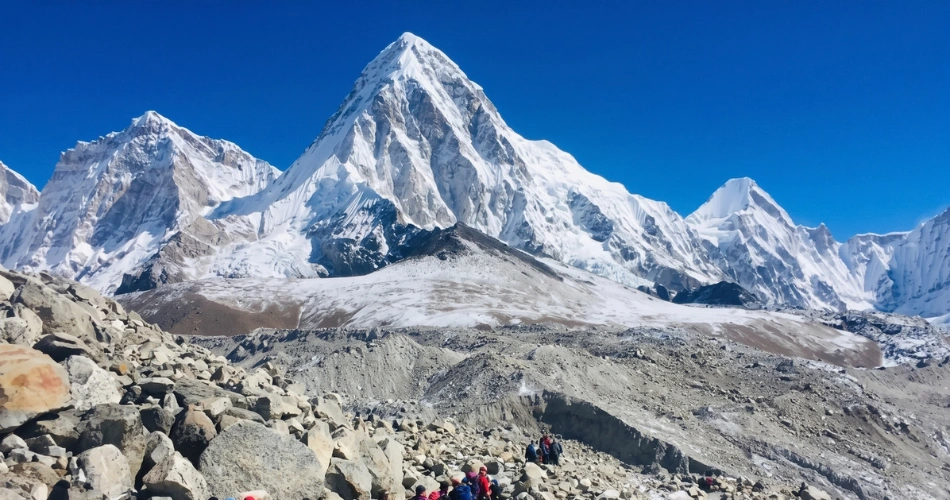
From here, magnificent mountains such as Ama Dablam, Lhotse, Nuptse, and Everest dominate the horizon. The trail then leads toward Dingboche, Lobuche, and finally Gorakshep. From Gorakshep, you will make the unforgettable journey to Everest Base Camp at 5,364 meters. Standing at the base camp of the world’s highest mountain is an emotional and deeply rewarding moment. Surrounded by dramatic glaciers, ice formations, and towering Himalayan peaks, you will have the opportunity to appreciate just how extraordinary the Everest landscape truly is. The following morning begins early with a hike toward Kala Patthar, the highest point of the trek at 5,545 meters. If weather conditions are favorable, sunrise from Kala Patthar reveals an extraordinary panorama of Everest, Nuptse, Lhotse, Pumori, Ama Dablam, and many other Himalayan peaks. After the sunrise experience, rather than retracing the entire trail back to Lukla, you will return to Gorakshep and board a helicopter. The flight from Gorakshep to Lukla provides an entirely different perspective of the region. From above, you can see the valleys, glaciers, villages, forests, and enormous Himalayan peaks that you experienced on foot. At Desire Adventures, we carefully design this trek to balance adventure, acclimatization, safety, and comfort. Our experienced guides support you throughout the journey, helping you enjoy the trail while adapting responsibly to high altitude. The helicopter return also makes this itinerary particularly attractive to travelers who want to experience Everest Base Camp but have limited time or prefer not to undertake the lengthy downhill trek.
More than simply reaching Everest Base Camp, this journey is about the entire experience – the warm hospitality of the Sherpa people, prayer flags moving in the mountain wind, ancient monasteries, dramatic suspension bridges, peaceful Himalayan villages, and the unforgettable feeling of standing beneath the world’s highest mountain.
What's covered
Includes & Excludes
✓ Included
- Arrival and departure airport transfers by private vehicle.
- 2 nights’ accommodation in Kathmandu with breakfast at a tourist-standard hotel, based on twin sharing.
- Ramechhap Airport transfers by shared jeep/minivan when flights operate from Ramechhap, generally during April - May and October - November.
- Kathmandu - Lukla - Kathmandu direct flights during periods when flights operate directly from Kathmandu, generally June - September and December–March.
- Ramechhap - Lukla - Ramechhap flight tickets when flights operate from Ramechhap.
- Shared helicopter flight from Gorak Shep to Lukla after completing the Everest Base Camp trek.
- Three daily meals - breakfast, lunch, and dinner - during the trek.
- All trekking accommodation in comfortable local lodges on a twin-sharing basis.
- 4 nights of accommodation with attached bathrooms and hot showers during the trek: 1 night in Phakding, 2 nights in Namche Bazaar, and 1 night in Lukla.
- Seasonal fresh fruits served after dinner each evening during the trek
- Unlimited purified drinking water throughout the trek, except in Gorak Shep.
- All required trekking permits and entry fees for the Everest region.
- Experienced, government-licensed, English-speaking trekking guide, including salary, meals, accommodation, transportation, insurance, and other necessary expenses.
- Porter service, with one porter assigned for every two trekkers, including the porter's salary, meals, accommodation, transportation, and insurance.
- Accident and medical insurance for the guide and porters.
- All applicable local and government taxes.
- Company duffel bag for use during the trek.
- Everest Base Camp trekking map.
- Basic first-aid kit and pulse oximeter carried by the trekking team.
- Adventure certificate upon successful completion of the trek.
- Farewell dinner in Kathmandu after completing the adventure.
✕ Excluded
- Nepal tourist visa and arrival visa fees.
- Lunch and dinner in Kathmandu, except for the included farewell dinner.
- Personal expenses, including tea, coffee, mineral/bottled water, soft drinks, alcoholic beverages, and other personal refreshments.
- Additional hot showers beyond the 4 hot showers included in the package.
- Wi-Fi, battery/phone charging, and laundry services during the trek.
- Excess baggage charges on flights to/from Lukla. The included baggage allowance is up to 15 kg per person, subject to the applicable airline regulations.
- Travel insurance, which must include coverage for high-altitude trekking, emergency medical treatment, helicopter evacuation above 5,000 meters, and trip cancellation/interruption.
- Any additional or extended trekking programs, tours, transportation, or accommodation not specified in the itinerary.
- Additional accommodation and meals in Kathmandu if you return earlier than the scheduled itinerary due to personal reasons or other circumstances.
- Personal trekking and travel equipment, unless specifically mentioned in the inclusions.
- Tips for guides, porters, drivers, and other supporting staff, which are customary and given at the traveler's discretion as an appreciation for their service.
Day by Day
Full Itinerary
Welcome to Kathmandu, the historic and culturally rich capital of Nepal. Upon your arrival at Tribhuvan International Airport, a representative from Desire Adventures will meet you and provide a warm welcome before transferring you comfortably to your hotel. Once you have settled in, you will have time to relax and recover from your journey. Depending on your arrival time and energy level, you may wish to take a gentle walk around the lively streets of Thamel, one of Kathmandu's most popular tourist areas.
The neighborhood is filled with restaurants, cafés, trekking shops, handicraft stores, and traditional Nepali influences. Later in the day, you will meet your trekking guide and receive a detailed briefing about the Everest Base Camp Trek. Your guide will explain the itinerary, altitude considerations, trekking conditions, equipment, safety procedures, and other important information to help you prepare for the adventure ahead. If you have any last-minute trekking equipment to purchase or rent, our team can assist you with the arrangements. Kathmandu has a wide range of trekking shops where essential equipment can be found. In the evening, you can enjoy your first taste of authentic Nepali cuisine before getting a good night's rest. The following morning marks the beginning of your journey toward the world's highest mountain.
Your Everest adventure begins early in the morning. During the peak trekking seasons, flights to Lukla are generally operated from Manthali Airport in Ramechhap due to increased air traffic at Kathmandu's Tribhuvan International Airport. The drive from Kathmandu to Ramechhap normally takes around 4–5 hours, so you will leave very early, often around 1:00–2:00 AM, depending on the flight schedule.
The journey by road provides an opportunity to see the changing landscapes of central Nepal as you travel toward the eastern hills. After arriving at Ramechhap Airport, you will complete the airport formalities and board a short domestic flight to Lukla. The approximately 15–20-minute flight is an exciting introduction to the Everest region. As the aircraft approaches Lukla, you will see increasingly dramatic mountain terrain and green hills before landing at Tenzing-Hillary Airport, one of the world's most famous mountain airstrips. After meeting the local trekking team, you will begin your first walk toward Phakding. The trail gradually descends and follows sections of the Dudh Koshi Valley, passing through small settlements, Buddhist prayer flags, stone walls, and forested landscapes. The relatively short trek is intentionally designed to give your body time to begin adapting to the altitude. You will reach Phakding in the afternoon, giving you plenty of time to relax at the lodge, enjoy the surrounding scenery, and prepare for the longer trek toward Namche Bazaar the following day.
After breakfast, you will begin one of the most exciting sections of the Everest Base Camp trail as you make your way toward Namche Bazaar, the commercial and cultural heart of the Khumbu region. The trail follows the Dudh Koshi River through beautiful pine, fir, and rhododendron forests. You will pass through charming mountain settlements such as Toktok and Banker, where traditional stone houses, cultivated fields, waterfalls, and dramatic mountain scenery create a wonderful introduction to the Everest landscape.
As you continue north, the trail crosses several suspension bridges decorated with colorful prayer flags. The sound of the rushing Dudh Koshi River accompanies you for much of the journey. You will eventually reach Monjo, where your trekking permits are checked before entering the protected area of Sagarmatha National Park. From here, the trail continues toward Jorsale and follows the river before crossing the famous Hillary Suspension Bridge. After crossing the bridge, the trail becomes steeper as you begin the final climb toward Namche.
The ascent can feel demanding, but the excitement grows as the first views of Everest and other Himalayan peaks begin to appear. After several hours of walking, you will arrive at Namche Bazaar, dramatically positioned in a natural amphitheater surrounded by mountains. Namche is more than just a resting point. It is a lively Sherpa settlement with cafés, bakeries, shops, lodges, markets, and a rich mountain culture.
Today is an important acclimatization day in Namche Bazaar. Rather than continuing directly to higher elevations, you will spend the day allowing your body to adjust gradually to the increasing altitude. After breakfast, you will take a scenic acclimatization hike toward Syangboche and the Hotel Everest View area. The trail climbs steadily above Namche and rewards you with magnificent views of Everest, Lhotse, Nuptse, Ama Dablam, Thamserku, and Kongde, weather permitting. Hotel Everest View is one of the most popular viewpoints in the area and provides a spectacular setting to enjoy the Himalayan panorama.
After spending some time taking photographs and enjoying the scenery, you can continue toward the traditional Sherpa villages of Khumjung and Khunde. These villages provide a wonderful opportunity to experience everyday Sherpa life away from the busier trekking route. You may see traditional stone houses, cultivated fields, monasteries, and local schools. After exploring the villages, you will gradually descend back to Namche Bazaar. The entire excursion generally takes around 5–6 hours, but the pace will be comfortable and adjusted according to the group's condition. The rest of the afternoon is free to relax, explore Namche, visit local cafés, or prepare your equipment for the higher sections of the trek.
After breakfast, the trail leaves Namche Bazaar and follows a beautiful mountain path overlooking the Dudh Koshi Valley. This is one of the most scenic sections of the trek, with magnificent views of Everest, Lhotse, Nuptse, Ama Dablam, and Thamserku appearing throughout the journey. The trail initially follows a relatively comfortable route through forested hills before gradually descending toward the river. Along the way, you will pass through small settlements and peaceful forest areas filled with pine, fir, rhododendron, and juniper trees. After crossing the Dudh Koshi River, the trail begins a steady climb toward Tengboche, one of the most important spiritual destinations in the Everest region. Tengboche is home to the famous Tengboche Monastery, an important center of Tibetan Buddhist culture in the Khumbu.
Depending on the monastery's schedule, you may have the opportunity to observe monks performing prayers or simply explore the peaceful surroundings. The location of Tengboche is extraordinary, with Ama Dablam rising dramatically above the valley and other major Himalayan peaks forming an impressive backdrop. After spending time at the monastery and enjoying the views, you will continue downhill through the forest toward Deboche, a quieter settlement surrounded by trees and mountains. The shorter walking distance after Tengboche allows you to enjoy the surroundings without rushing. You will spend the evening relaxing at your lodge and preparing for the higheraltitude journey ahead.
Today's trek takes you deeper into the high Himalayas as you leave the forests behind and gradually enter the drier alpine landscape of the Khumbu Valley. After breakfast, the trail follows the Imja Khola Valley toward Pangboche. Along the way, you will enjoy increasingly impressive views of Ama Dablam, one of the most recognizable mountains in the Everest region.
The landscape gradually becomes more open as the elevation increases. You will pass traditional villages, mani walls, prayer stones, and fields surrounded by stone walls that protect crops from the harsh mountain climate. The trail eventually crosses the Imja Khola and continues toward Dingboche. The final approach to the village provides spectacular views of the surrounding mountains, making it one of the most memorable sections of the trek.
Dingboche is a beautiful high-altitude settlement surrounded by impressive Himalayan peaks. Because of its elevation, the village experiences a much colder and drier climate than the lower areas. Once you arrive at the lodge, you can enjoy a warm meal and take some time to relax. Your guide will also monitor the group's health and make sure everyone is adapting well to the increasing altitude. Dingboche is an important acclimatization point before continuing toward Lobuche and Gorakshep, so a comfortable evening and good night's sleep are particularly valuable.
Today is another important acclimatization day before heading toward the higher elevations of Lobuche, Gorakshep, and Everest Base Camp. Rather than spending the entire day resting at the lodge, we recommend a gradual acclimatization hike. Depending on weather conditions and the group's energy level, your guide may recommend hiking toward Nagarjun Hill or exploring the Chhukung Valley. The Nagarjun hike provides excellent views of Ama Dablam, Lobuche East, Lobuche West, Kangtega, Taboche, and other surrounding peaks.
The climb can be demanding because of the altitude, but you will maintain a slow and steady pace. If conditions and group fitness allow, exploring toward Chhukung provides another beautiful perspective of the Imja Valley and surrounding mountains. The purpose of today's hike is not to cover a large distance but to help your body adapt to the thinner air at higher elevations. Your guide will monitor your condition throughout the day and adjust the program if necessary.
After returning to Dingboche, you will have time to relax, enjoy the mountain scenery, and prepare your equipment for the challenging days ahead. The atmosphere in Dingboche is peaceful and distinctly Himalayan. Sitting outside with a warm drink while looking toward Ama Dablam is an experience in itself.
Today, the landscape becomes increasingly rugged as you continue toward Lobuche, one of the final major settlements before Everest Base Camp. After breakfast, you will follow the trail toward Duglha and Thukla, walking through the upper section of the Pheriche Valley. The surrounding landscape is dramatic, with towering mountains and wide glacial valleys replacing the forests you encountered during the earlier part of the trek.
The trail gradually climbs toward Thukla. After taking a short rest and enjoying lunch, you will begin the more challenging ascent toward Thukla Pass, also known as Thukla Memorial or Thukla Viewpoint. This section is both physically demanding and emotionally powerful. At the top of the pass, you will find memorials dedicated to climbers and Sherpas who lost their lives while pursuing their dreams in the world's highest mountains. The memorials stand among the enormous Himalayan peaks and serve as a moving reminder of the risks involved in highaltitude mountaineering. After spending some quiet time at the memorial area, you will continue along the increasingly barren trail toward Lobuche. The air will be noticeably thinner at this elevation, so your pace will be deliberately slow and steady. Upon reaching Lobuche, you will check into your lodge, have a warm meal, and rest for the evening.
Today is one of the most anticipated days of your Everest Base Camp adventure. You will wake early, have breakfast, and begin the trek toward Gorakshep, the final settlement before Everest Base Camp. The trail follows the rugged Khumbu Glacier valley, with spectacular views of Nuptse, Pumori, and other towering peaks. The terrain becomes increasingly rocky and challenging, and the thin air means that you will walk slowly with regular breaks.
After reaching Gorakshep, you will take a short rest and continue toward Everest Base Camp. The trail follows the edge of the Khumbu Glacier, passing through dramatic glacial terrain and rocky moraine. Finally, you will reach Everest Base Camp at 5,364 meters. Standing beneath the world's highest mountain is an extraordinary achievement. During the climbing season, you may see expedition tents and mountaineering activity, although the exact appearance of Base Camp varies according to the season and conditions. Take time to celebrate your achievement, photograph the surrounding landscape, and appreciate the incredible journey that brought you here. After enjoying Everest Base Camp, you will retrace your steps back toward Gorakshep.
The return journey can feel tiring, but knowing that the following morning brings a spectacular Kala Patthar sunrise and helicopter flight provides an exciting motivation. You will spend the night at Gorakshep, preparing for an early start the next morning.
Today begins before sunrise with one of the highlights of the entire journey—the hike to Kala Patthar at 5,545 meters. With headlamps lighting the trail, you will slowly climb toward the viewpoint. Although the early morning ascent can be challenging because of the altitude and cold, the reward is extraordinary.
As the sun begins to rise over the Himalayas, the mountains gradually turn golden. Mount Everest, Nuptse, Lhotse, Pumori, Ama Dablam, and other peaks create an unforgettable panoramic scene. Kala Patthar is widely considered one of the best viewpoints for seeing Mount Everest from the Khumbu Valley. After spending time enjoying the sunrise and taking photographs, you will descend back to Gorakshep for breakfast. The next part of the day offers a completely different experience. Instead of beginning the long trek back toward Lukla, you will board a helicopter from Gorakshep to Lukla, subject to weather conditions, visibility, helicopter availability, and operational regulations. The flight provides a breathtaking aerial perspective of the landscapes you have just crossed on foot. From above, you can see glaciers, valleys, mountain villages, suspension bridges, and some of the world's highest peaks. After landing in Lukla, you can relax at your lodge and celebrate the completion of the trekking portion of your adventure.
After breakfast, you will prepare for your return flight from Lukla. Depending on the season, airline schedule, and current airport operations, your flight may arrive at Ramechhap/Manthali Airport or operate directly to Kathmandu. If the flight is operated to Ramechhap, you will continue the journey by road from Manthali to Kathmandu. The drive normally takes approximately 4–5 hours, depending on road and traffic conditions. The return journey provides a chance to reflect on the incredible experiences of the past several days. From the first exciting flight into Lukla to the trails through Sherpa villages, the monasteries of Tengboche, the high Himalayan valleys, Everest Base Camp, Kala Patthar, and the helicopter flight, you will have experienced some of Nepal's most spectacular landscapes. Upon arrival in Kathmandu, you will be transferred to your hotel. The remainder of the day is free for relaxation, shopping, exploring, or simply enjoying a comfortable shower and a wellearned rest.
You may also choose to enjoy a farewell dinner with your guide and trekking team, depending on your schedule.
Your unforgettable Everest Base Camp adventure comes to an end today. Depending on your international flight schedule, you will have some free time in Kathmandu for last-minute shopping, relaxing at your hotel, or enjoying a final walk through the historic streets of the city. At the appropriate time, a representative from Desire Adventures will transfer you to Tribhuvan International Airport for your onward journey. As you leave Nepal, you will take home much more than photographs. You will carry memories of walking beneath some of the world's highest mountains, meeting warm and welcoming Sherpa communities, visiting ancient Buddhist monasteries, crossing suspension bridges above rushing Himalayan rivers, standing at Everest Base Camp, watching sunrise from Kala Patthar, and flying above the Khumbu by helicopter. We hope your time in Nepal becomes a story you will continue to share for many year
Physical Preparation
Difficulty & Fitness
Moderate-StrenuousWhat to Bring
Packing List
Everything you need for a comfortable and safe trek. Items marked Required are essential.
Gears
-
Sleeping Bag 4-season sleeping bag, Sleeping bag linerCan Rent
-
35 - 40-liter daypack waterproof rain coverRequired
-
Headlamp with spare batteriesRequired
-
UV-protection sunglasses Spare pair of sunglasses, if preferredRequired
-
Personal prescription medicationsRequired
-
Basic pain-relief medicationRequired
-
Personal hygiene and medical suppliesRequired
Clothing
-
Warm puffy/down jacket Rental available for USD 25Required
-
Sun hat or trekking capRequired
-
Warm knitted hat or beanieRequired
-
Scarf or neck gaiterRequired
-
Technical or moisture-wicking base layerRequired
-
2 short-sleeve technical shirtsRequired
-
2 long-sleeve technical shirtsRequired
-
Fleece jacket or warm pulloverRequired
-
Waterproof and windproof outer shell jacketRequired
-
Warm insulated/down jacketRequired
-
Lightweight thermal top for colder sections of the trekRequired
-
Technical or thermal base-layer trousersRequired
-
2 pairs of comfortable hiking pantsRequired
-
Comfortable trousers for wearing inside teahousesRequired
-
Waterproof and windproof outer shell pantsRequired
-
Hiking shorts, particularly for warmer lower-altitude sectionsRequired
-
Lightweight thermal leggings for colder conditionsRequired
-
Lightweight wool or technical liner glovesRequired
-
Warm insulated outer glovesRequired
-
Waterproof gloves for colder or snowy conditionsRequired
-
Quick-drying technical underwearRequired
-
Sports bras, if requiredRequired
-
Comfortable sleeping clothes or pajamasRequired
-
Lightweight thermal underwear for colder nightsRequired
Footwear
-
Waterproof trekking/hiking boots with good ankle supportRequired
-
Warm wool or technical trekking socksRequired
-
Regular hiking socksRequired
-
Lightweight liner socks, optionalRequired
-
Comfortable casual shoes or sandals for teahousesRequired
-
GaitersRequired
-
Microspikes or ice cleatsRequired
Additional Information
More Details
Important Information About the Trek
Weather, Flights and Itinerary Flexibility
Mountain trekking is naturally influenced by weather and conditions beyond our control. Although we follow the planned itinerary as closely as possible, flight delays or cancellations, adverse weather, natural disasters, government regulations, political situations, trail conditions, or a trekker's health may require changes to the schedule. Our experienced team will assess the situation carefully and make the safest and most practical arrangements possible. Your cooperation and flexibility are especially important when traveling in the high Himalayas.
Recommended Buffer Days
We strongly recommend keeping one or two additional days available after the trek, particularly if you have an international flight connection. Flights between Lukla and Kathmandu/Ramechhap can sometimes be delayed or canceled because of weather and operational conditions. Having additional days provides valuable flexibility and reduces the risk of missing your international flight. You can also extend your Nepal experience with additional activities before or after the trek, including Kathmandu sightseeing, Chitwan National Park, Pokhara, rafting, cultural tours, or other Himalayan adventures.
Lukla Flight Information
During the main trekking seasons-March, April, May, September, October, and November-flights to Lukla generally operate from Manthali Airport in Ramechhap, approximately 4–5 hours by road from Kathmandu, due to increased air traffic at Tribhuvan International Airport. During the relatively quieter months-January, February, June, July, August, and December-Lukla flights generally operate from Kathmandu. Flight operations are determined by the airlines and relevant aviation authorities and may vary depending on passenger volume, weather, airport operations, and other factors. Weather conditions, airport congestion, runway conditions, and the challenging mountain terrain can all contribute to flight delays or cancellations. For this reason, keeping additional time in your overall Nepal itinerary is highly recommended.
Duffel Bag and Luggage Allowance
Desire Adventures provides a free 65-liter duffel bag during your pre-trip meeting in Kathmandu. This bag is used for the clothing and trekking equipment that will be transported by your porter. Normally, one porter is assigned for every two trekkers. We recommend keeping the duffel bag at approximately 15 kg (33 lbs) or within the applicable flight baggage allowance. For the Kathmandu–Lukla flight, the total baggage allowance is generally limited, so it is important to pack efficiently. Your trekking duffel and daypack should remain within the airline's permitted weight limits. Any excess baggage may be stored securely at your Kathmandu hotel or our office and collected after your trek.
Respecting Local Culture
The Everest region is home to the Sherpa people, whose culture and traditions are an important part of the trekking experience. We encourage visitors to dress respectfully, particularly when visiting villages, monasteries, and religious sites. Some very tight or form-fitting clothing, such as yoga pants or similar garments, may be considered inappropriate in certain local communities. If you choose to wear such clothing for comfort while trekking, it is respectful to wear a longer shirt, jacket, or other covering over it when appropriate.
Pack Light, Trek Comfortably
You do not need to bring everything you own for the Everest Base Camp Trek with Helicopter Return. A carefully planned packing list will make your journey much more comfortable. Desire Adventures can also assist you with equipment rental, luggage storage, and practical packing advice during your pre-trip meeting in Kathmandu. With the right clothing, footwear, and essential equipment, you can focus on enjoying the spectacular landscapes, Sherpa villages, monasteries, and unforgettable views of the Everest region.
Trek Route
Route Map
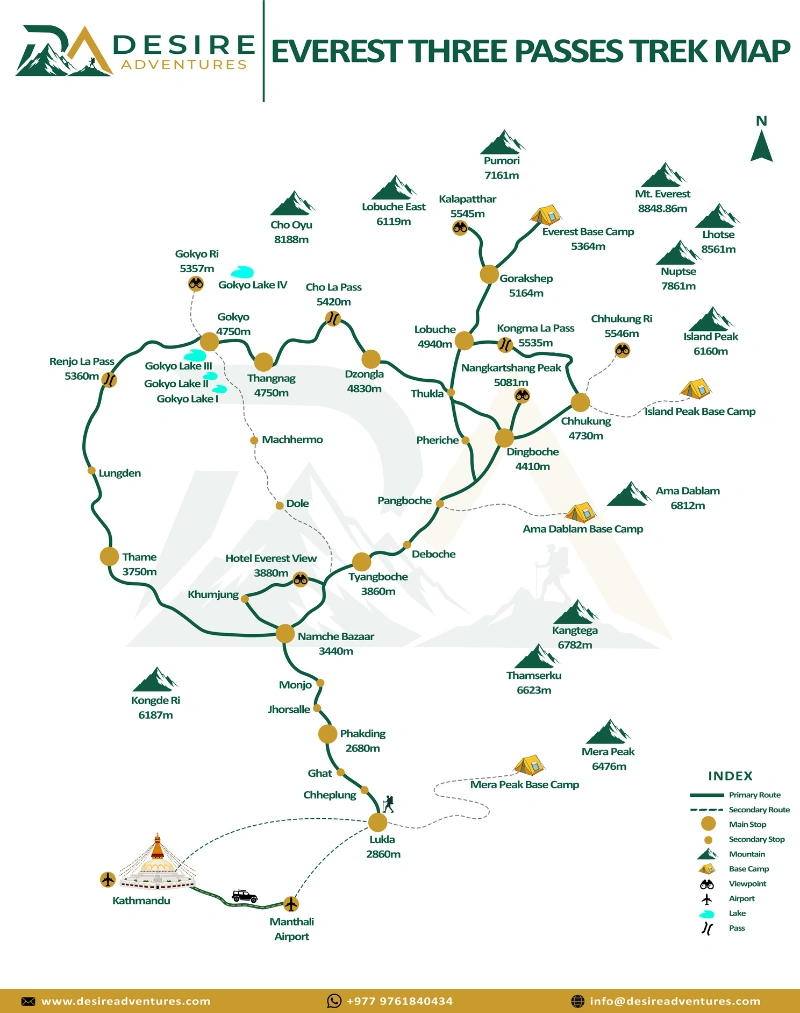
Elevation Profile
Altitude Chart
Elevation profile across 12 days. Maximum altitude: 5,364m
Common Questions
Frequently Asked
The Everest Base Camp Trek with Helicopter Return is a popular way to experience the Everest region while saving time and avoiding the long return trek. You trek through the beautiful Khumbu Valley to Everest Base Camp, explore the surrounding Himalayan landscapes, and then return to Lukla by helicopter from Gorakshep. The journey combines trekking, Sherpa culture, spectacular mountain scenery, and a scenic helicopter flight, making it an excellent option for travelers with limited time.
The duration depends on the itinerary and acclimatization schedule. A typical program takes around 12 days, including arrival and departure arrangements in Kathmandu. Desire Adventures can also customize the itinerary according to your available time, fitness level, and travel preferences.
Yes, when you book the Everest Base Camp Trek with Helicopter Return package, the helicopter return is included according to the selected itinerary and package conditions. The exact helicopter operation may depend on weather, flight regulations, availability, and operational conditions.
Yes. You do not need previous high-altitude trekking experience to complete the Everest Base Camp Trek. However, you should have reasonable physical fitness and be prepared for several hours of walking each day at increasing elevations.
Weather in the Everest region changes significantly with altitude and season. Spring and autumn generally offer favorable trekking conditions, with clearer mountain views and relatively stable weather. Temperatures become considerably colder as you gain altitude, particularly around Lobuche, Gorak Shep, and Everest Base Camp. Nights can be below freezing, so proper layering and warm clothing are essential.
The main trekking seasons are spring (March–May) and autumn (September–November). These months generally provide good visibility and favorable trekking conditions. Winter trekking is also possible with appropriate preparation, while the monsoon months can bring rain, clouds, and flight disruptions.
Yes. Helicopter flights in the Himalayas depend heavily on visibility, wind, cloud conditions, and other operational factors. If weather conditions are unsuitable, the helicopter may be delayed or rescheduled for safety reasons. Desire Adventures closely monitors the situation and works with the helicopter operator to make appropriate arrangements.
Most foreign travelers require a tourist visa to enter Nepal. Nepal offers tourist visa facilities on arrival at Tribhuvan International Airport for eligible nationalities, and visas can also be obtained through Nepalese diplomatic missions abroad. Current visa requirements and fees should always be checked with the Department of Immigration of Nepal before traveling.
Current tourist visa fees listed by Nepal's Department of Immigration are: 15 days: USD 30 30 days: USD 50 90 days: USD 125 Visa requirements and fees can change, so travelers should verify the latest information before departure.
Desire Adventures can provide general guidance about the Nepal visa process and the documents you need. However, the visa itself is issued by the Government of Nepal, so travelers should follow the official immigration procedures.
The inclusions depend on your selected package, but a typical package from Desire Adventures may include accommodation in Kathmandu and during the trek, meals during the trekking portion, an experienced guide and porters, required trekking permits, domestic transportation, and the helicopter return from Gorakshep to Lukla. We provide a detailed list of inclusions and exclusions before you confirm your booking.
Common personal expenses include: Nepal tourist visa International flights Travel insurance Personal snacks and drinks Wi-Fi and charging fees Personal shopping Tips for guides and porters Extra accommodation or meals caused by unforeseen delays Emergency evacuation or medical expenses not covered by your insurance
It is advisable to carry sufficient Nepalese rupees for personal expenses because card facilities and ATMs become increasingly limited as you travel higher into the mountains.
The trek is suitable for most healthy adults who are prepared for sustained walking at high altitude. There is no strict age limit, but fitness, health, previous experience, and individual ability should be considered.
Yes, age alone does not necessarily prevent someone from completing the trek. However, older trekkers should consult their doctor before undertaking a high-altitude trek and allow sufficient time for acclimatization.
Yes. Solo travelers can book a private trek or, depending on availability, join a scheduled group departure. Desire Adventures offers flexible arrangements for both solo travelers and private groups.