About This Trek
Everest Base Camp Trek
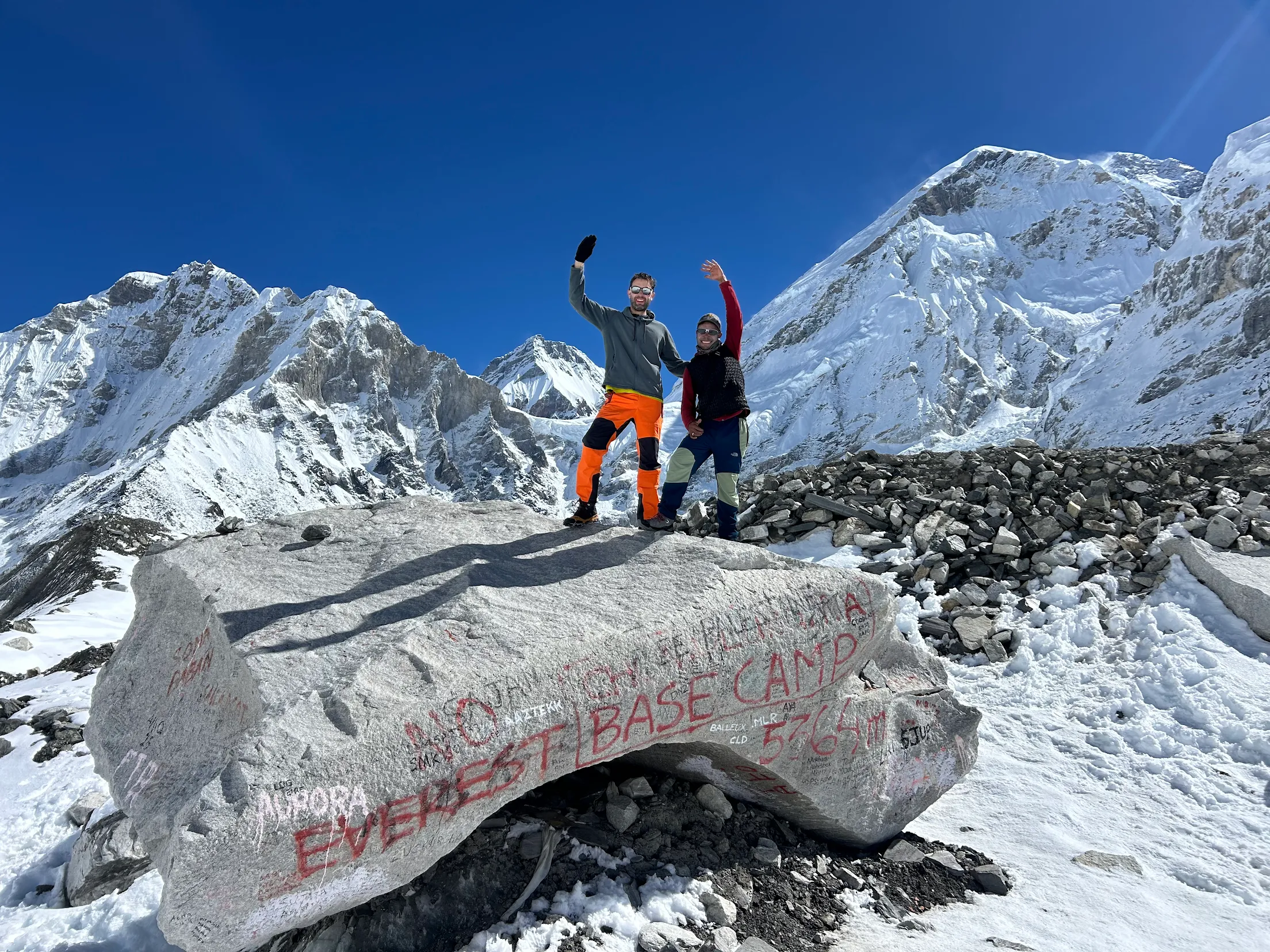
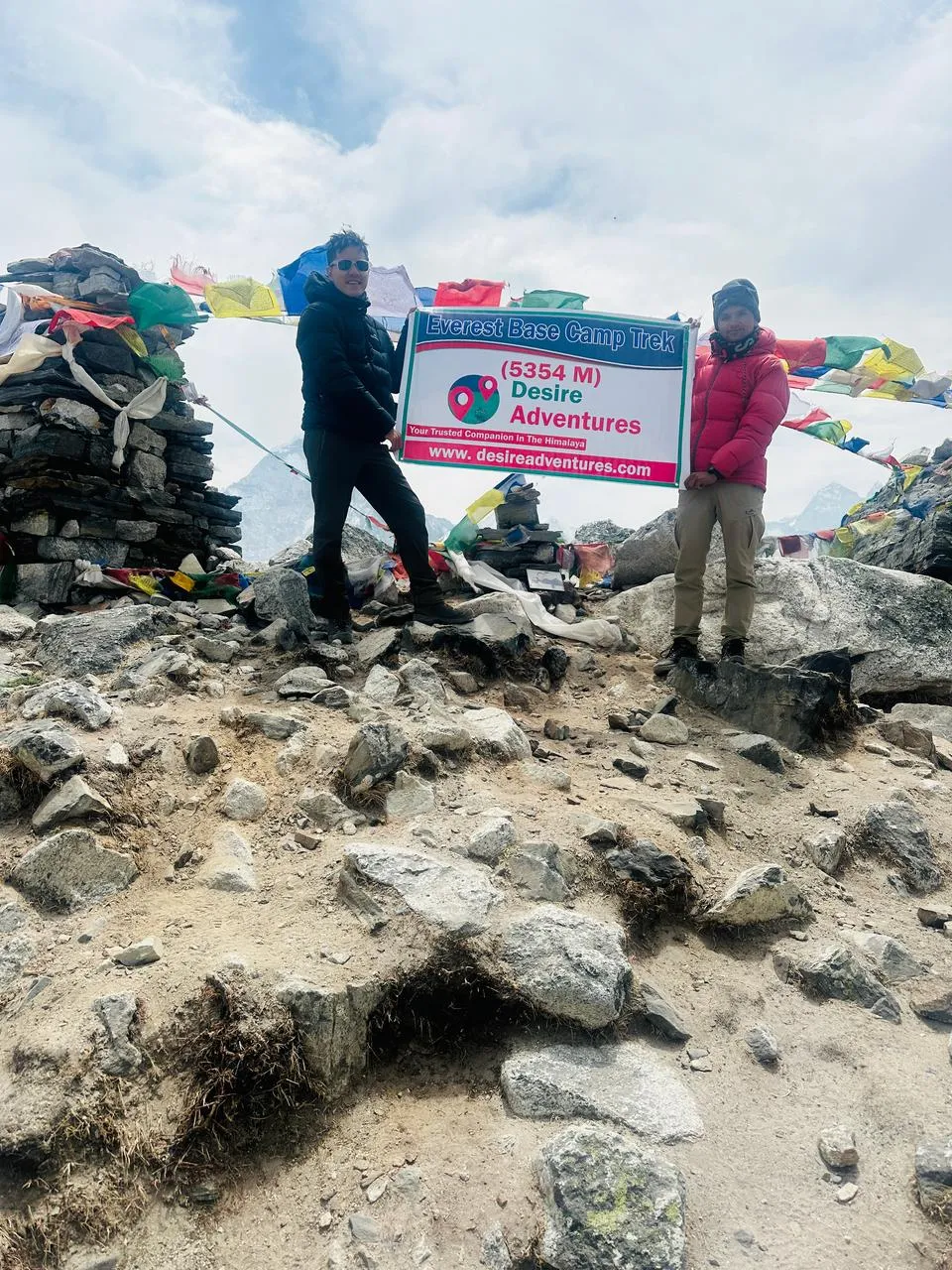
Our 14-day Everest Base Camp Trek is a challenging high-altitude journey built for determined hikers. As a licensed local agency, we manage your safety with expert guides, daily oximeter checks, unlimited purified water, and precise Ramechhap/Lukla flight logistics, ensuring you reach 5,364 meters without the typical operational delays. Now let’s dive into the Everest Base Camp Trek Package.
Everest Base Camp Route Overview:
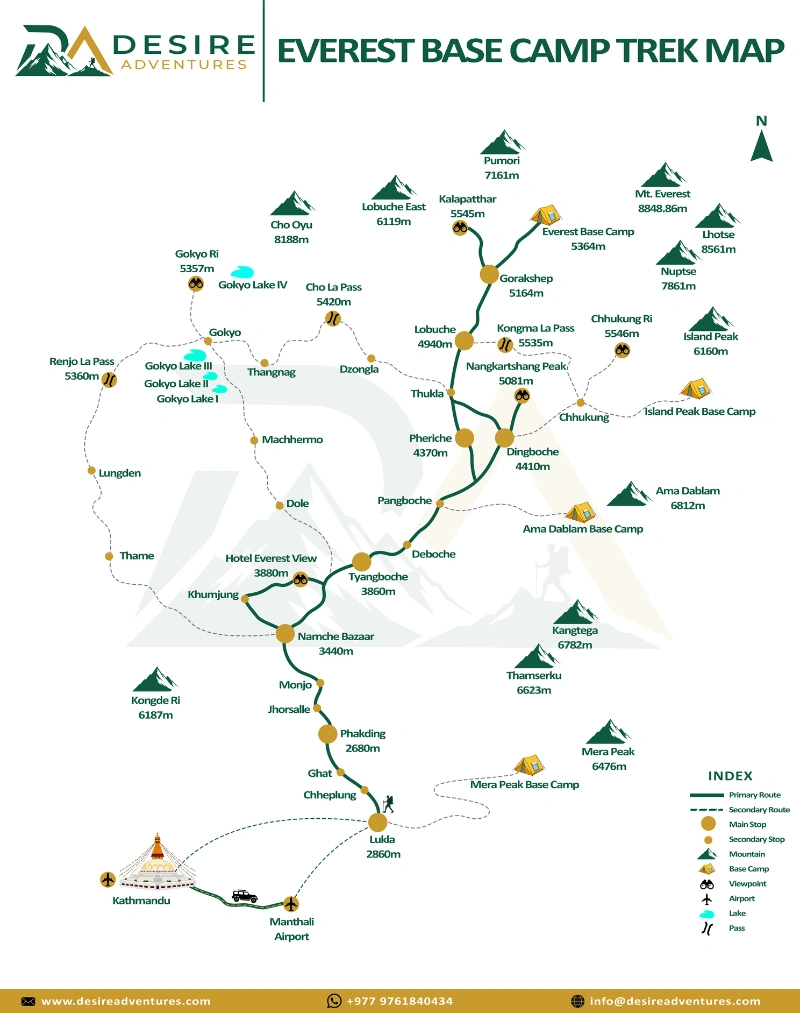
The journey to Everest Base Camp (5,364m / 17,598ft) is a demanding high-altitude trek through the heart of the Khumbu region. This route requires solid physical conditioning, mental resilience, and a respect for proper acclimatization. Starting from the mountain airstrip at Lukla, the trail climbs steadily along the Dudh Koshi River valley, cutting through alpine forests before rising well above the tree line into the rugged, exposed landscape of the high Himalayas.
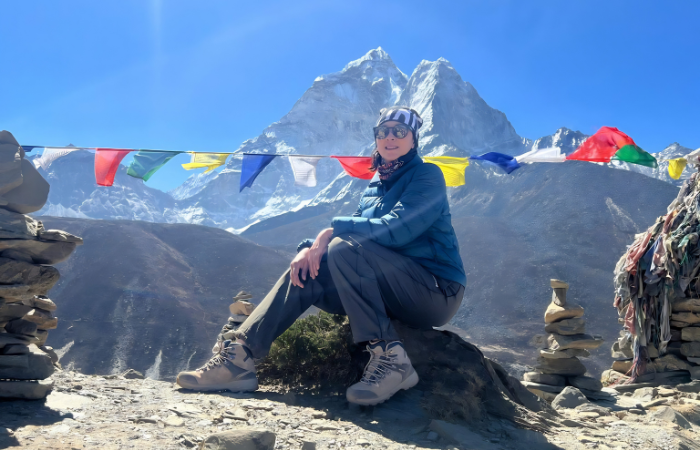
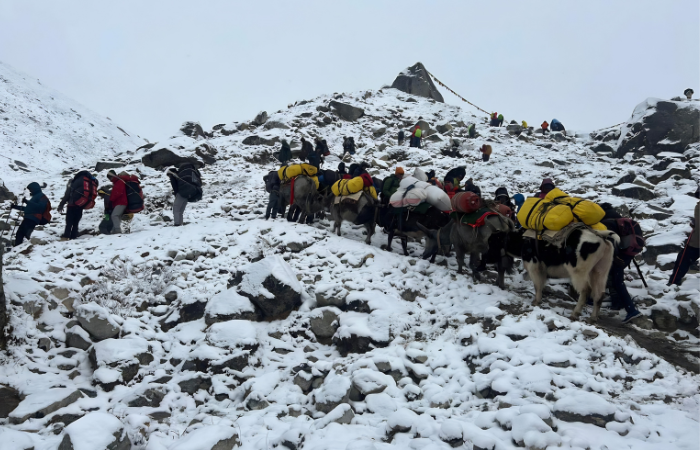
We have structured this 14-day itinerary to balance physical output with optimal acclimatization. You will navigate steep stone staircases, cross high suspension bridges, and walk over loose moraine. This is not a technical climb, but the thin air past Namche Bazaar makes every step an exercise in deliberate pacing. With Desire Adventure, you are accompanied by licensed local guides who monitor your blood oxygen levels daily, manage your pace, and handle the fluid logistics of high-altitude tea house hospitality, allowing you to focus entirely on the trail.
Why Trek to Everest Base Camp with Desire Adventure?
Booking a high-altitude trek requires absolute confidence in your local operator. At Desire Adventure, we do not run mass-tourism, cut-corner expeditions. We focus heavily on trail health, logistical transparency, and physical comfort to maximize your chances of safely reaching Base Camp.
Here is exactly how we run our treks differently from standard budget operators:
1. Elevated Trail Comfort: Private Bathrooms and Hot Showers
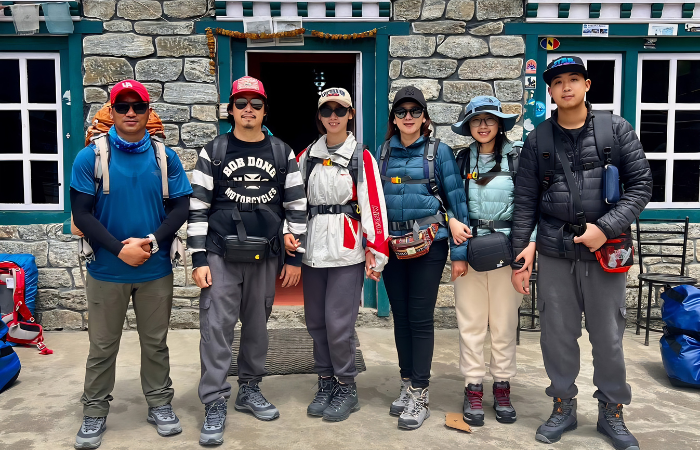
The Khumbu region is notorious for basic, freezing communal toilets. We deliberately upgrade your itinerary to include 5 nights of attached bathrooms with hot showers at no extra cost (1 night in Phakding, 3 nights in Namche Bazaar, and 1 night in Lukla). Having a private toilet and a warm shower during these critical acclimatization and recovery phases prevents illness and preserves your energy.
2. Standardized Nutrition: Unlimited Purified Water & Daily Fresh Fruit
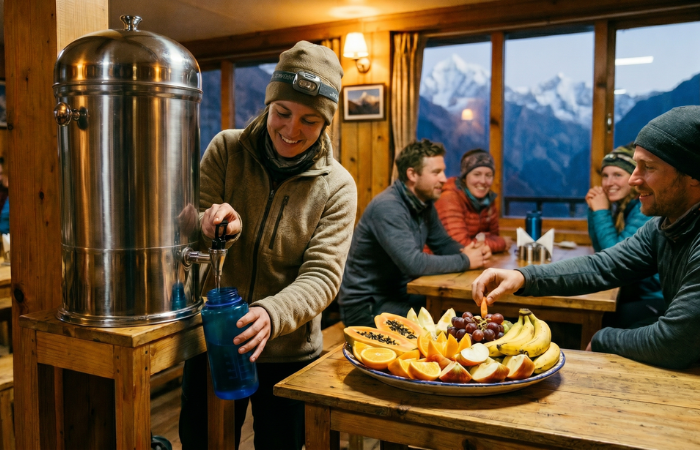
Safe Hydration: Staying hydrated is the single most effective way to combat Acute Mountain Sickness (AMS). Instead of making you buy expensive plastic bottles or chlorine tablets, we provide unlimited purified drinking water throughout the trek (except at Gorakshep).
Post-Dinner Nutrition: Trekking burns thousands of calories daily, and high-altitude diets can become heavily carbohydrate-reliant. We serve fresh seasonal fruits every single evening after dinner to keep your immune system strong and your digestion on track.
3. Rigorous Altitude Safety Protocols
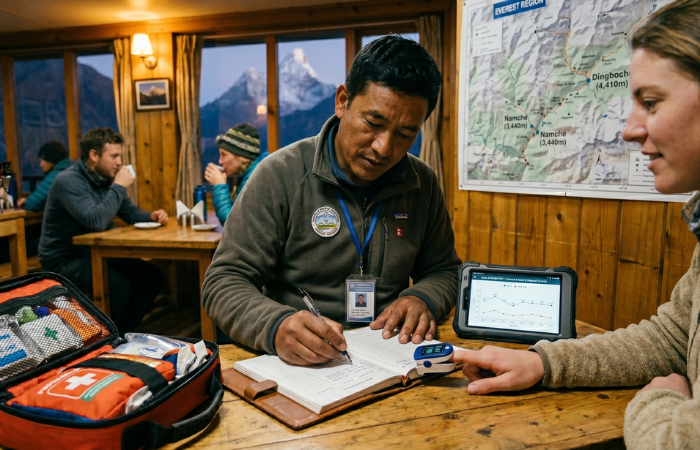
We do not wait for symptoms to become severe. Our government-licensed, English-speaking guides carry a professional medical kit equipped with a Pulse Oximeter on every single departure. We conduct daily blood-oxygen saturation and heart-rate checks every evening. This data allows our team to monitor how your body adapts to the thinning air past Namche (3,440m) and Dingboche (4,410m), making proactive safety decisions before you ever step foot on the trail.
4. Flawless Peak-Season Flight Logistics
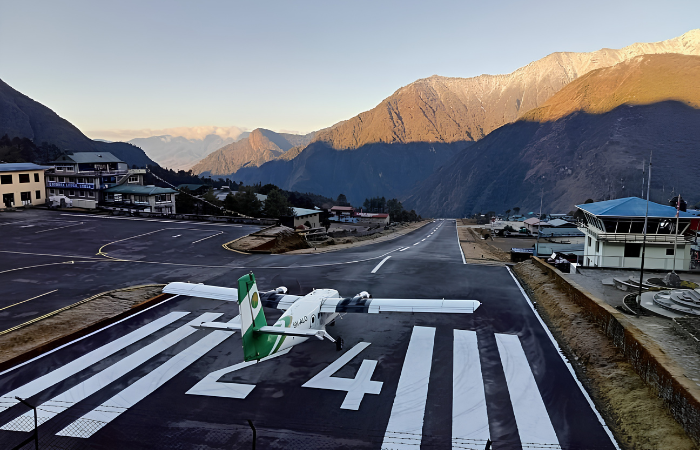
Flight diversions in Nepal cause major disruptions for trekkers. We are completely transparent about how we handle this: during the chaotic peak seasons (April–May and October–November), we arrange direct, reliable group transits to Ramechhap Airport via shared minivans to catch your short 15-minute flight to Lukla. During off-peak months, we transition smoothly to direct Kathmandu–Lukla flights. We manage the bookings directly, reducing runway wait times and minimizing contingency delays.
5. Fair-Trade Guiding and True Local Expertise
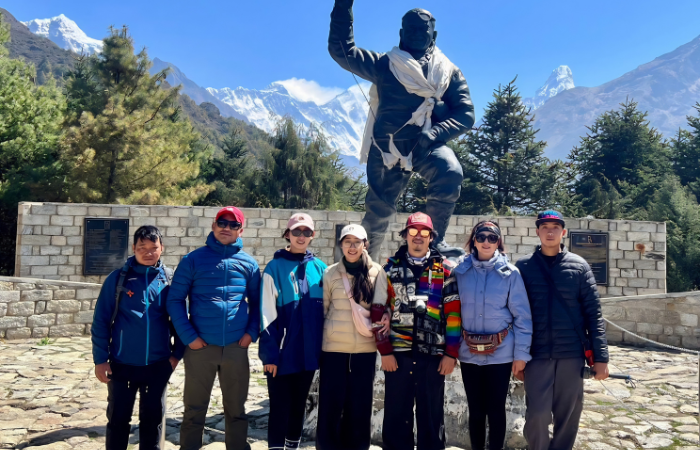
Our guides and porters are the backbone of our agency. We enforce a strict 1 porter to 2 trekkers ratio, ensuring our staff is never overloaded (maximum 30kg per porter). Every team member is fully insured, fairly compensated, and deeply familiar with the subtle changes in Khumbu terrain and weather patterns. When you trek with us, you are supported by an ethical, boots-on-the-ground local team.
14 Days Everest Base Camp Trek - DESIRE ADVENTURE
Trek to Everest Base Camp (5,364m) with Desire Adventure. Our 14-day package costs $1299 and includes Lukla flights, meals, and 5 nights of private bathrooms.
Product SKU: EVE-20260-1
Product Brand: Desire Adventure
Product Currency: USD
Product Price: 1299
Price Valid Until: 2030-09-30
Product In-Stock: InStock
5
What's covered
Includes & Excludes
✓ Included
- Arrival and departure transfer service (private car/jeep/minivan)
- 2 nights accommodation with breakfast in Kathmandu (Tourist Standard Hotel) on a twin-sharing basis
- Ramechhap airport transfer for domestic flights (April to May and October to November) during the peak season, (shared minivan)
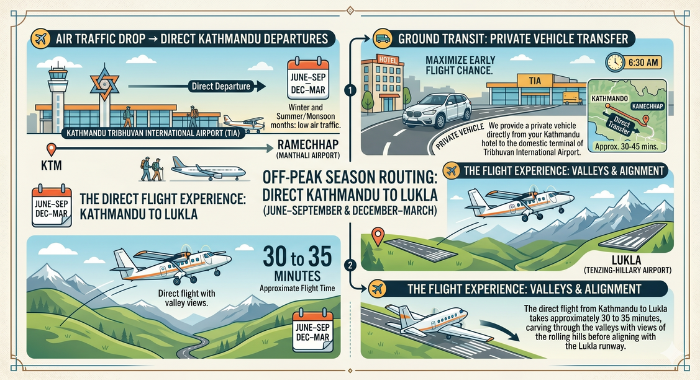
- Kathmandu - Lukla - Kathmandu direct flight (during June to September and December to March)
- Ramechhap - Lukla - Ramechhap flight (April, May and October, November) during the peak season
- Meals (Breakfast, Lunch, and Dinner) during the trek
- Seasonal fruits, every day after dinner, during the trek
- All accommodation (lodge/guesthouse) during the trek on a twin-sharing basis
- 5 nights attached bathroom with hot shower during the trek (1N- Phakding, 3N- Namche, and 1N- Lukla)
- Unlimited purified drinking water (except at Gorakshep) during the trek
- Sagarmatha national park entrance fee
- Local rural municipality entrance fee
- Government-licensed, English-speaking, experienced, and knowledgeable guide and his entire expenses
- A porter (One porter for each 2 members) and his entire expenses
- Insurance of guide and Porter
- All required local and government taxes
- Company duffle bag and trekking route Map
- Basic First-Aid Kit with Oximeter
- Adventure certificate upon completion of the trek
- Free coordination in emergency cases
- Farewell dinner
✕ Excluded
- Nepal arrival visa
- Meals in the city except breakfast and other mentioned special dinner
- Personal expenses like all kinds of drinks including mineral water, tea/coffee, alcoholic and soft beverages
- Wi-Fi & battery charging, and extra hot shower, laundry service while on a trek
- Extra baggage excess while flying to Lukla (only 15 kg included)
- Any other extended trips and accommodation
- Your travel insurance covers Helicopter evacuation over 5000 meters and trip cancellation
- Accommodation and meals in Kathmandu in case of early return from the trek
- Tipping to staff (as an appreciation)to service providers and any other extending trips/accommodation
Day by Day
Full Itinerary
Welcome to Nepal and Desire Adventures. Upon your arrival at the Tribhuvan International Airport in Kathmandu, you will be met by a company representative. After a quick meet and greet at the airport, you will be driven to your hotel booked for you in Kathmandu by private transfer. Spend some time at leisure. After a short rest, a meeting will be conducted either at your hotel, or our office, where you will be introduced to your guide and fellow travelers. The introduction session will be followed by a briefing that sketches out the wonderful trip that awaits you. Trekking gears and clothing that you will need during the trek will also be finalized in the same meeting. The time after the meeting can be spent at leisure.
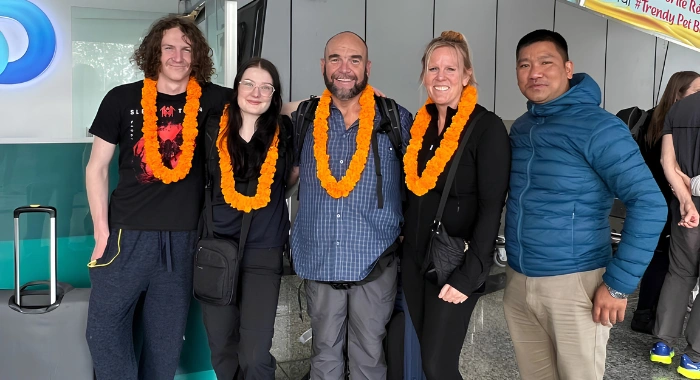
Since flights to and from Lukla during peak season operate from the Manthali Airport in Ramechhap, you will need to drive to Ramechhap. It’s approximately a 4-5 hour driver from Kathmandu. Therefore, you will start early in the morning around 1-2am. The drive to Ramechhap will be in a shared jeep. In Ramechhap you will board your plane to Lukla and fly to Lukla which takes around 15-18 minutes. It’s a scenic flight and on clear days the view beneath looks very delightful. The plane will land on one of the most dangerous airports in the world, the Tenzing Hillary Airport.
In Lukla, you will be introduced to your private porters. While the luggage is prepared for the porters, have your first breakfast in the Khumbu region, enjoying the spectacular snow-capped Himalayan Mountain that backdrops the town of Lukla. After breakfast, accessing the narrow streets, you will head through the north end of Lukla past the police checkpoint (get your trekking card and register your passport) to the Pasang Lhamo Memorial Gate.
Enjoy colorful prayer flags, shops, people and yaks walking through the streets and leave Lukla for Phakding. The trail will drop to the village of Cheplung and continue through the community forest to the metal suspension bridge above the Thado Koshi Khola. Enjoy the first views of the Dudh Koshi River and Kusum Kangru.
You will now climb around the ridge to Ghat, pass through a school and enter a complex of Mani walls, chortens, and boulders engraved with black and white Tibetan mantra and prayer wheels. The trail will then climb to Chhuthawa and wind through the forest beside the Dudh Koshi. You will further continue to the village of Phakding, where you will check into your lodge, before enjoying a well-earned dinner and a night of rest. In the afternoon, if you are not tired you will go for an acclimatization hike to the monastery located near Phakding and get back to the lodge for overnight stay.
After enjoying your breakfast, you will continue on a trail that first cuts across to the west bank of the Dudh Koshi River and meandering through the forest of pine about 100m above the river, follows the Dudh Koshi Valley north to the tiny village of Toktok. However, you will cross the Ghatte Khola by the small hydroelectric project and climb up over the ridge, before reaching this village.
From Toktok, you will descend through the forest of pine to Benkar, past a few small waterfalls. Here you will get to enjoy a very good view of the potato fields. Heading north, you will now cross the bridge to get to the east bank of the Dudh Koshi River and walk to Chumoa, enjoying a few small settlements scattered among the wonderful forest of rhododendron, magnolia and fir.
A short climb from Chumoa will take you to Monjo. Just above Monjo lies the entrance check point for the Sagarmatha National Park, where your guide will take care of the required formalities. Meanwhile you can enjoy 3D map of the Khumbu Himalaya and displays on responsible trekking at the information center in Monjo.
The trail drops down to the suspension bridge past a stupa-shaped gateway (Kani) and an enormous granite bluff carved with Tibetan mantras. You will cross the bridge and hike north to Jorsale. Above Jorsale, you will cross the suspension bridge across the Dudh Koshi River, get to the east bank, follow the lower river bank trail over gravel and boulders and climb into the forest.
Soon you will see the confluence of Bhote Koshi and Dudh Koshi rivers. Crossing the bridge across the Dudh Koshi River, you will now hike through the forest of pine on a zigzag trail up till Mislung, where the path levels out and the forest ends. Following the stone steps, you will continue till Namche, where you will check into your lodge before dinner. Your evening is spent at leisure. We suggest exploring the town of Namche and enjoying cafes.
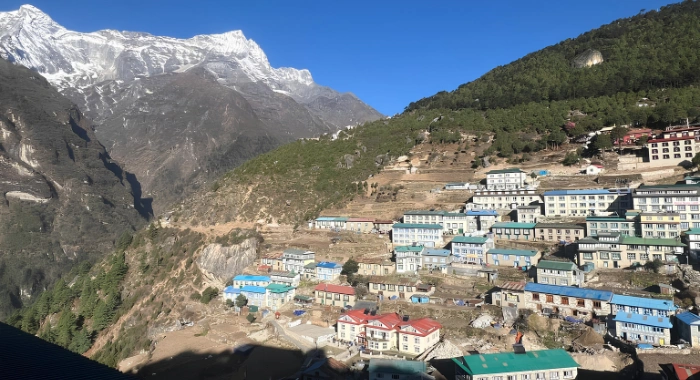
One day acclimatization in Namche is highly recommended to avoid the symptoms of AMS, further up the trail. For this, you can choose from a number of short hikes through the hills around Namche. Among all, Namche Bazaar to Thame (6-7 hours) and a full day circuit through Syangboche, Khunde and Khumjung and back to Namche (4-5 hours) are the best recommended acclimatization treks in Namche.
The Namche-Thame hike will take you west along the valley of the Bhote Koshi to the isolated village under the mountain wall of Kongde Ri. Choosing this trail allows you to enjoy enormous mani boulders carved with Buddhist mantras, forest of pine and rhododendron, ancient mud plastered stupa at Phurte, boulder with a painted image of Guru Rinpoche at Samshing, large chorten, Kani, stone-walled fields; murals of Green Tara, Guru Rinpoche and Thangtong Gyalpo; Thame Gompa and a hydro electric power house.
However, a full day circuit through Syangboche, Khunde and Khumjung to Namche allows you to enjoy grass airstrip at Syangboche, juniper and rhododendron, carved boulders, Boudhanath-style chortens; delightful view of Khumbila, Ama Dablam and Thamserku peak; the first hospital in the Khumbu; Khunde Tsamkhang- a Buddhist temple founded by a lama who fled from Tingri in Tibet; 360 degree views of Khunde, Namche Bazaar, Ama Dablam and Pachermo peak from the Hillary Memorial Viewpoint; memorial chortens to Edmund Hillary, his wife and daughter; beautiful view and the settlement of Khumjung – the largest village in Khumbu; potato fields of Khumjung; Hillary School established by Sir Edmund Hillary; the longest mani wall in the Khumbu region and a gompa that treasures the skull of a Yeti.
Enjoy your breakfast and follow your guide to one of these side trips. This acclimatization trek will help you adjust to the altitude without any unsafe increase in elevation. In the evening you will get back to Namche for dinner and accommodation.
After breakfast in Namche, you will leave for Tengboche. Following the path by the huge Mani stone in Chhorkung, you will now continue north around a long ridge. Very soon, walking past a memorial chorten to Tenzing Norgay, backdropped with a beautiful panorama of Thamserku to Amadablam, Lhotse and Everest, you will reach a trail junction at Sanasa past Kyangjuma. Leaving the trails that climb to Khumjung and Gokyo and following the descending trail, you will now descend to Leushyasa, enjoying the majestic view of Ama Dablam. Below Leushyasa, a steep descent on stone steps will take you down to a bridge at Phunki Thenga.
You will cross the bridge, walk past some water driven prayer wheels and continuously climb up through the forest of rhododendron, past a number of rest points and springs to finally reach Tengboche.
Kani and a pair of chorten mark the arrival of Tengboche after about two hours of demanding uphill climb. Some lucky trekkers also get to spot a few musk deer and Himalayan Thar in the forest on the way to Tengboche.
In Tengboche you will check into the lodge and after a short rest enjoy a strolling tour of Tengboche Monastery (the largest and the most active monastery in the Khumbu region) complex taking in the highlights with your private guide and enjoying the panorama of peaks including, Tawache, Everest, Nuptse, Lhotse, Ama Dablam and Thamserku. Enjoy the remaining time at leisure.
Note: Instead of Tengboche, if you prefer sleeping at a lower altitude, you can also choose to hike down to Deboche (20-25 mins from Tengboche), which will give you better accommodation options, good night sleep and make the next day shorter and easier.
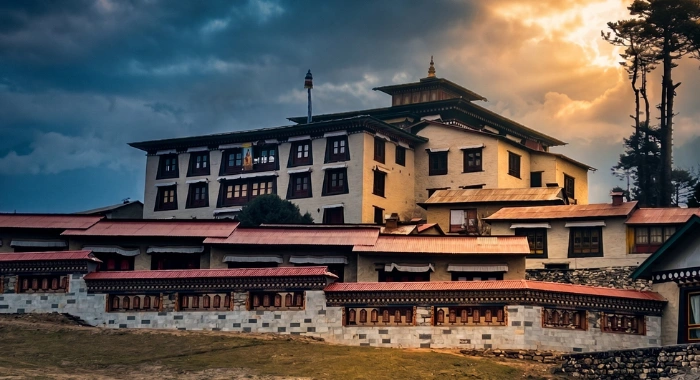
You can join the monks for morning prayers at the Tengboche Monastery. After enjoying your breakfast in Tengboche, you will now leave Tengboche for Dingboche. From Tengboche, you will gradually descend to the bridge at Chaturje on stone steps, enjoying the lush forest.
A big chorten greets you at the other end of the bridge. You will now continue further on a slowly ascending Pheriche trail as far as Orsho, which drops to a small bridge across the Khumbu River at Chuto. Crossing the bridge, you will climb for about 30 minutes along the west bank of the Imja River to finally reach the village of Dingboche. Enjoy snowcapped summits of Island Peak, Peak 38 and Lhotse to the east of Dingboche. After reaching the village you will check into the lodge. The rest of the time is spent at leisure. You can utilize this time by exploring the settlement of Dingboche under your own steam, before dinner.
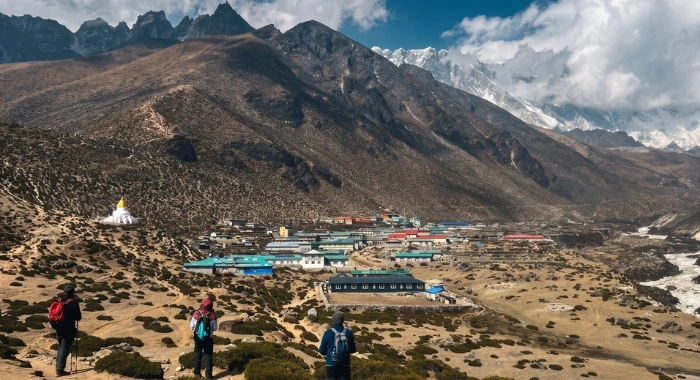
To aid the acclimatization process, one more day acclimatization in Dingboche is highly recommended. You can choose from two acclimatization trek options: i) hike to Nangkar Tshang Gompa and the viewpoint above it, ii) a full-day hike to Chhukung.
If you are looking for a short hike, then the first option is suggested. It’s about an hour climb past chortens and prayer flags to the ridge north of Dingboche, where you can enjoy Nangkar Tshang Hermitage. Take in the highlights with your guide and continue up the hill side to the viewpoint to enjoy the beautiful view of Cholatse and Taboche to the north, lakes at the foot of Ama Dablam and Chhukung and Makalu to the east.
However, if you are looking for a longer acclimatization trek, a full-day hike to Chhukung in the upper Imja Valley is suggested. Starting Dingboche, the major part of the climb is over desolate moraine to a series of stepping stones over Niyag Khola until Bibre. Chhukung (4,730m), surrounded by mountains and glaciers, is nestled among ridges of moraine about 30 minutes west of Bibre. If you have time and energy to walk, you can climb Chhukung RI for mind-blowing panorama of Ama Dablam, Baruntse and Makalu.
After enjoying your breakfast your team leader will guide you to one of these destinations in Dingboche. After the acclimatization trek, you will get back to Dingboche for dinner and accommodation.
After enjoying your breakfast, you will leave Dingboche for Lobuche. You will either follow the trail that crosses to Pheriche through the stupas atop the ridge or take another trail and slowly climb along the ridge to the Pheriche and Dingboche trail junction, past Dusa. As you tread the trail, the grandest view of the craggy twin peaks of Taboche and Cholatse, Ama Dablam and Kantega provide a very good company.
From the junction you will descend to a glacial stream, before rising up the other side to Dughla (Thukla). You will now head directly up the rough terminal moraine of the Khumbu Glacier. After walking for about an hour, the trail slightly curves left at the top of the ridge, where you come across a number of memorials to the lost climber and Sherpas, including memorials to Babu Chhiri Sherpa and Scott Fisher.
After crossing the ridge, the stupendous Pumori comes into view. A little ahead from this point, you will come across a trail junction from where an arduous ascent to the north over loose moraine will take you to Lobuche. You will check in to the lodge at Lobuche. The rest of the day is spent at leisure. You can best utilize the time hiking up the ridge east of the village to enjoy the first view of the Khumbu Glacier along with Lhotse and Nuptse or take a leisurely walk north, along the moraine to the Italian Pyramid and get back to the lodge in Lobuche for dinner and accommodation.
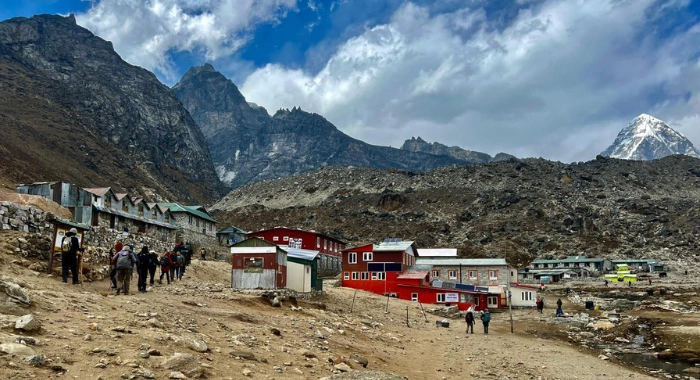
Wake up to the thought of standing on the base camp of Mt. Everest and enjoy your breakfast in Lobuche. After breakfast, you will head north, following the narrow trail between the glacial moraine and the mountain wall; traverse the junction to the Italian Pyramid.
After a few short vertical climbs you will walk across the terminal moraine of the Changri Shar Glacier, for about 45-50 minutes to finally reach Gorakshep, situated at the base of Kala Pattar. Enjoy the view of Changtse, Khumbutse, Lingtren and Pumori, from Gorak Shep. From Gorakshep, you will head back towards the Khumbu Glacier through loose sand and gently ascend to the top of the ridge and follow the mountain’s spine directly north towards the end of the Khumbu glacier. Soon, colorful tents (during climbing season) and brightly colored prayer flags wedged between rocks at the bottom of the Khumbu Icefall come into view, marking the base camp of Mt. Everest. You will spend some time taking picture and enjoying the surrounding view and retrace your steps to Gorak Shep for dinner and accommodation.
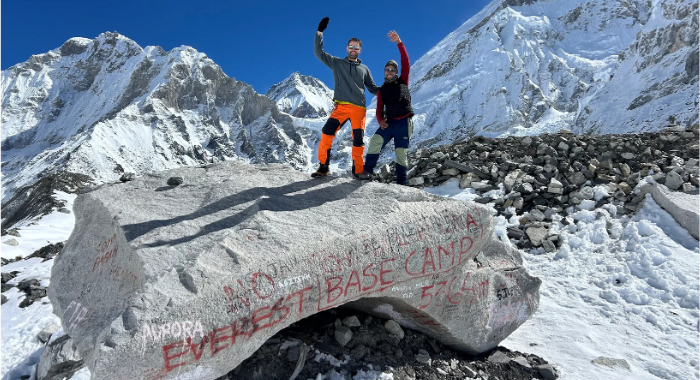
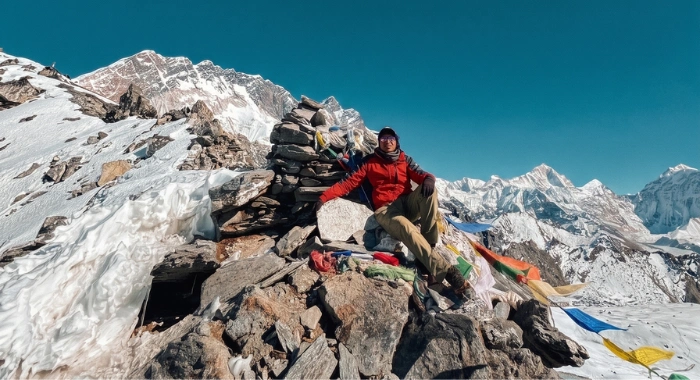
If your target is to enjoy the view of the sunrise over Mt. Everest and other Himalayan giants, you will have to start 2 hours before sunrise, as it takes 2 hours to hike all the way up to the summit of Kala Pattar. Starting early also provides the best chance to capture the view of the Everest, before the clouds roll in, obscuring the view. Therefore, before breakfast you will hike to Kala Pattar. You will reach the summit in about 1.5-2 hours, depending upon your speed.
As you approach the peak, the peak of Pumori becomes more prominent. Fluttering colorful prayer flags greet you at the summit of Kala Patthar. Enjoy the astonishing 360 degree panorama from Pumori and Lobuche West to Nuptse, Lhotse and Everest; the view of the frozen river of Khumbu glacier, the Everest Base Camp, tiny Gorak Shep and Lho La (the pass between Nepal and Tibet). After enjoying the view you will get back to Gorak Shep after a detour south to the lower ridge to enjoy the view of the glacial lakes, which is also the base camp for Pumori.
Lunch at Gorak Shep and you will retrace your steps along the moraine of the Khumbu Glacier to Lobuche. From Lobuche, you will continue down the moraine to Dughla, drop down to the bridge, cross the glacial stream and following the lower path that drops along the wide valley continue to Pheriche. After reaching Pheriche, you will check into the lodge and spend the remaining time at leisure, before dinner.
Note: From here, if you want to take a Helicopter Ride Back to Kathmandu to save 3 days of you time then we can arrange a Helicopter Ride with a small fee. You can ask your guide for Heli back or customize your itinerary with us.
Breakfast in Pheriche and you will leave for Namche. A gentle hike from Pheriche will take you to Pheriche Pass from where you will hike down to a trail junction at Chuto. Now, following the west bank of the Imja River, you will drop down to Pangboche, past Orsho and Somare. You will further retrace your steps to Tengboche through the forest past Deboche. From Tengboche, you will first climb down to Phunki Tenga, climb the ridge and continue towards Namche Bazaar. You will check into the lodge and spend the remaining time at leisure, before dinner.
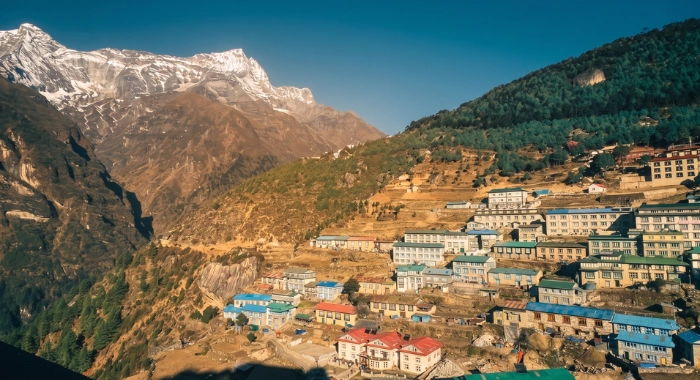
After breakfast in Namche, you will continue on a trail that steeply drops down to the confluence of Dudh Koshi and Bhote Koshi River, at Larja Dobhan. Crossing the Larja Bridge, you will now continue on a level path till Jorsale and climb up to Monjo. After the national park check out formalities, retracing the steps you will hike down to Phakding and hike up to Lukla. Check into the lodge in Lukla and spend the remaining time celebrating the achievement made over past few days. Enjoy dinner and accommodation in Lukla.
Last breakfast with a view in Lukla and get ready to board a plane back to Ramechhap or Kathmandu Domestic Airport. From Ramechhap you will be transferred to your hotel in Kathmandu in a shared minivan. The van will stop for lunch and a few toilet breaks on the way to Kathmandu.
A 4-5 hour drive will bring you back to Kathmandu from Ramechhap. You can either spend the afternoon at leisure. In the evening, we will meet for the farewell dinner, where while having dinner, we will also discuss the trip and the feedback. After dinner, you will be guided to your hotel for overnight stay.
Note: Sometime, you can get a direct flight back to Kathmandu too. You will get a private vehicle for a pick up during the flight back to Kathmandu.
Your 14 days Everest Base Camp trek vacation has come to an end. As per your flight schedule, you will be transferred to the Tribhuvan International Airport in a private vehicle to help you catch your international flight back home or your next destination.
Physical Preparation
Difficulty & Fitness
Moderate-StrenuousFitness level of Moderate to God Level is required. Need to have stamina and strength to walk 5-8 hours Daily while carrying 5kg daypack.
What to Bring
Packing List
Everything you need for a comfortable and safe trek. Items marked Required are essential.
Clothing
-
Moisture-Wicking Base Layers (3 Pairs)Required
-
Mid-Layers (2 Fleeces)Required
-
Insulation Layer 1 Down JacketRequired
-
Outer Shell Layer 1 Jacket, PantsRequired
-
Trekking Pants 2 PairsRequired
Footwear
-
Main Hiking Boots Waterproof, high-ankle support bootsRequired
-
Camp Shoes A pair of lightweight running shoesRequired
-
Trekking Socks (4 Pairs)Required
-
Liner Socks (2 pairs)Required
-
Gloves lightweight touch-screen compatible liner glovesRequired
Headwear
-
Buff / Neck Gaiter (2 Pieces)Required
-
Sun Hat / Cap wide-brimmed hatRequired
-
Warm Beanie insulated wool or fleece hatRequired
-
Polarized SunglassesRequired
Gear
-
Four-Season Sleeping Bag Rated down to at least -15°CRequired
-
Trekking Poles One pair of sturdy, adjustable trekking polesRequired
-
Headlamp high-lumen headlampRequired
-
Water Vessels (2 Liters Total CapacityRequired
-
High-Capacity Power Banks (20,000mAh+)Required
-
Sunscreen & Lip BalmRequired
-
Personal Hygiene KitRequired
Additional Information
More Details
Choosing Your Trekking Season: Weather and Trail Conditions
Trekking in the Himalayas requires aligning your trip with predictable weather windows. The Khumbu region experiences drastic seasonal changes that affect trail safety, flight reliability, and visibility. We break down the trekking calendar into four distinct seasons so you can choose the right window for your physical comfort and photography goals.
The Peak Seasons: Best Visibility and Stable Weather
1. Spring (March to May) - The Climbing Window
Temperature: Day temperatures range from 10°C to 15°C (50°F to 59°F) in the lower valleys, dropping to -10°C (14°F) at night above Dingboche.
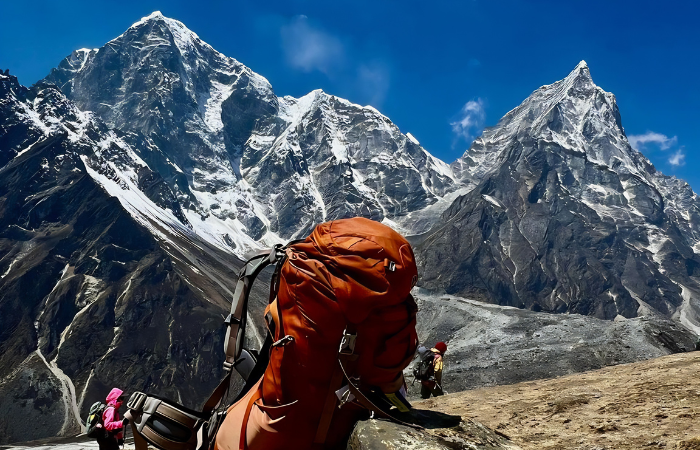
Trail Reality: This is the most vibrant time on the trail. Below the tree line, forests are thick with blooming red and pink rhododendrons. At Base Camp, you will walk through a bustling tent city filled with international expedition teams preparing for their Everest summit attempts.
Logistics Note: Because this season draws the highest volume of trekkers, Ramechhap flight routing applies in April and May to bypass Kathmandu air traffic. Trails and tea houses are busy, making advanced booking essential.
2. Autumn (September to November) - The Peak Clarity Window
Temperature: Similar to spring, with daytime temperatures averaging 12°C (53°F) and plunging to -15°C (5°F) at high elevations by late November.
Trail Reality: This window offers the sharpest, most consistent mountain views. The monsoon rains have just washed the dust from the air, leaving deep blue skies and crisp, unobstructed panoramic views of Ama Dablam and Everest. The climbing teams are gone, but the trekking routes are at their highest capacity.
Logistics Note: Ramechhap flight routing applies in October and November. October is historically the busiest month in the Khumbu; we secure tea house allocations months in advance to ensure our groups have quality twin-sharing rooms.
The Off-Peak Seasons: Cold and Monsoon Realities
3. Winter (December to February) – The Cold and Quiet Window
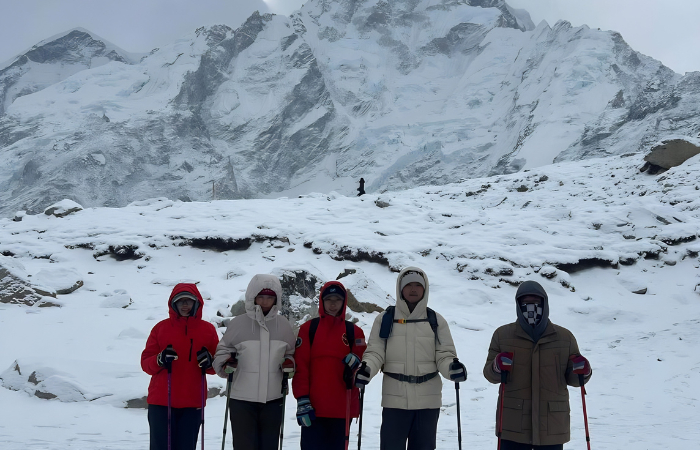
Temperature: Highs rarely exceed 5°C(41°F) in the day, while nighttime temperatures at Gorak Shep regularly hit -20°C(-4°F).
Trail Reality: The trails are completely empty, and the air is exceptionally clear. However, the cold is intense. Water in tea house pipes freezes overnight, communal areas are heated only by central yak-dung stoves during dinner, and high passes can close due to sudden snow accumulation.
Logistics Note: Direct Kathmandu–Lukla flights operate during this period, but weather-related delays are common. We recommend this season only to experienced winter hikers with specialized cold-weather gear.
4. Monsoon (June to August) – The Rainy Window
Temperature: Warm and humid, ranging from 15°C to 22°C (59°F to 72°F)
Trail Reality: Heavy rain dominates the lower sections of the trek, leading to muddy trails, frequent landslides in the valleys, and active leeches. Clouds regularly obscure the peaks, meaning you may trek for days without seeing the mountains.
Logistics Note: Flights to Lukla face chronic, multi-day cancellations due to low visibility and heavy fog. We do not recommend standard trekking during these months.
Navigating the Lukla Flight: Kathmandu vs. Ramechhap Routing
Flying into Tenzing-Hillary Airport in Lukla (2,840m) is one of the most logistically fluid parts of any Everest expedition. Due to extreme air traffic congestion at Kathmandu’s international airport and the unpredictable weather patterns of the Khumbu region, aviation authorities split the flight operations based on peak and off-peak months.
At Desire Adventure, we do not leave you guessing about your departure point. Here is exactly how your transit will operate depending on when you choose to trek.
Peak Season Routing: Ramechhap to Lukla (April-May and October-November)
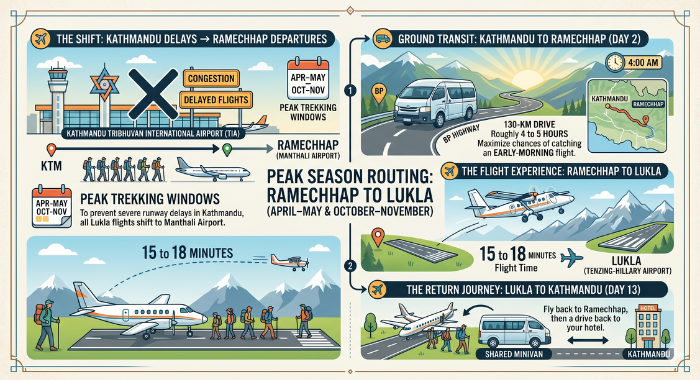
During the clear spring and autumn trekking windows, hundreds of hikers head to the Everest region daily. To prevent severe runway delays in Kathmandu, the Civil Aviation Authority of Nepal shifts all Lukla flights to Manthali Airport in Ramechhap.
The Ground Transit: On Day 2 of your itinerary, we arrange a shared minivan to drive you from Kathmandu to Ramechhap. This is a 130-kilometer drive along the winding BP Highway that takes roughly 4 to 5 hours. To maximize our chances of catching an early-morning flight before the mountain winds pick up, we start this drive in the early hours of the morning.
The Flight Experience: Once at Ramechhap, you board a twin-otter or dornier STOL (Short Take-Off and Landing) aircraft. The flight from Ramechhap to Lukla takes just 15 to 18 minutes.
The Return Journey: On Day 13, you will fly back from Lukla to Ramechhap, where our shared minivan will be waiting to drive you back to your hotel in Kathmandu.
Strict Baggage Weight Restrictions
Domestic airlines operating the Lukla route enforce rigid weight limits for safety reasons on these small aircraft.
The Weight Limit: Your total combined baggage allowance is strictly 15 kg (approx. 33 lbs) per passenger. This is split into 10 kg for your main checked duffle bag (carried by your porter) and 5 kg for your personal technical daypack (carried by you).
Excess Weight: If your gear exceeds 15 kg, you can pay an excess baggage fee directly to the airline at the airport counter during check-in. This fee typically costs around $1 to $2 USD per extra kilogram. However, we highly recommend staying within the limit; our packing list is optimized to keep your duffle under 10 kg while retaining all essential cold-weather layers.
Handling Weather Delays and Flight Contingencies
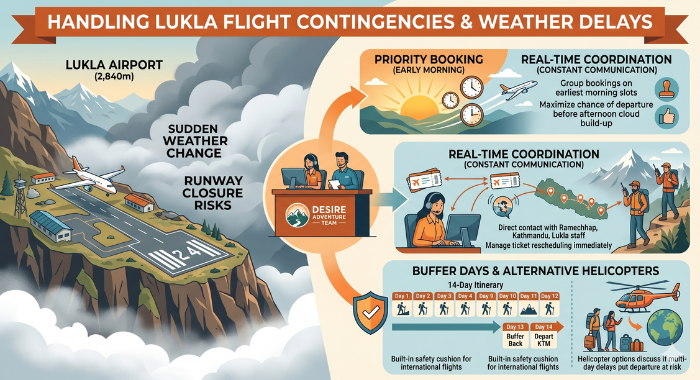
Lukla airport sits on a shelf at 2,840 meters, surrounded by massive ridges. High winds, shifting cloud cover, and sudden valley fog can shut down the runway instantly. Delays are a normal part of Himalayan aviation, and any agency that promises a guaranteed on-time departure is lying to you.
Here is how our Desire Adventure team manages contingencies on the ground:
Priority Booking: We deliberately book our groups onto the earliest possible morning flight slots. Early flights have a much higher success rate because cloud cover typically builds up in the afternoon.
Real-Time Coordination: Our office maintains constant communication with airport staff in Ramechhap and Kathmandu, as well as our guiding team already in Lukla. If a flight is delayed, we manage the ticket rescheduling for you.
Buffer Days: Our 14-day itinerary includes your travel back to Kathmandu on Day 13 and departure on Day 14. This provides a built-in safety cushion. If flights are grounded for multiple days and your international departure is at risk, we will immediately discuss alternative helicopter options with you to ensure you make your flight home.
Tea House Living: What to Expect for Accommodation and Food
Trekking to Everest Base Camp does not mean roughing it in tents, but it does mean adjusting to the unique realities of Himalayan tea houses. These are locally-owned, mountain lodges that provide shelter and hot meals. While lower elevations offer surprising comforts, amenities become basic and rustic the higher we climb.
At Desire Adventure, we handpick our lodges based on hygiene, structural warmth, and hospitality. Here is the realistic breakdown of how you will sleep and eat on our 14-day trek.
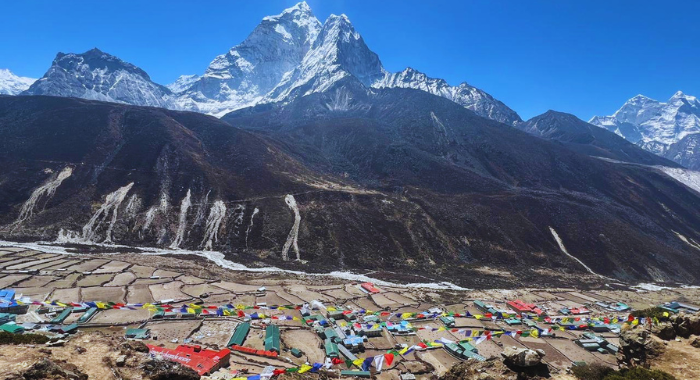
Accommodation: Standard Rooms vs. Our Upgrades
All standard packages in the Khumbu utilize twin-sharing rooms. These rooms are compact, unheated, and constructed with wood or plywood partitions. They contain two single beds with foam mattresses, pillows, and basic quilts.
Because proper sleep is vital for acclimatization, we deliberately upgrade your accommodation at key rest stops:
The Private Bathroom Upgrade (5 Nights Included): Cold communal toilets are the norm on this trail. To give your body the best environment to adapt, we provide 5 nights of rooms with private, attached bathrooms and hot showers at no extra charge: 1 night in Phakding (Day 2), 3 nights in Namche Bazaar (Days 3, 4, and 11), and 1 night in Lukla (Day 12).
High-Altitude Lodging (Tengboche, Dingboche, Lobuche, Gorak Shep): Past 3,800 meters, plumbing freezes overnight, making attached bathrooms rare and impractical. In these areas, you will use shared communal toilets (a mix of western-style sit-down and traditional Asian squat toilets). Rooms are cold, so while we provide blankets, you must bring a high-quality, four-season sleeping bag rated to at least -15°C (5°F).
The Dining Room Hub: While your bedroom remains cold, the communal dining hall is heated every evening using a central iron stove fueled by dried yak dung. This is where our groups gather to eat, dry gear, play cards, and debrief with our guides.
Food & Fuel: Nourishing Your Body at High Altitude
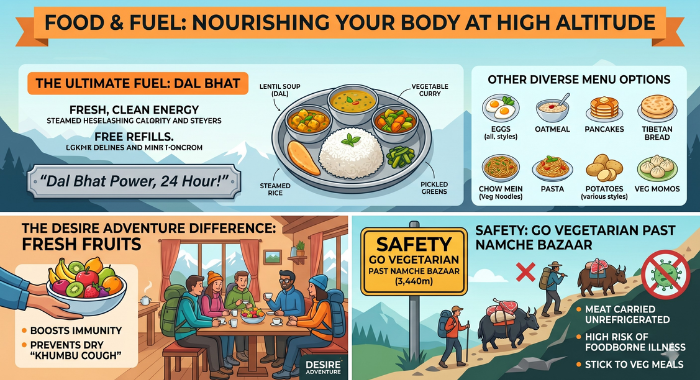
Trekking for 5 to 8 hours a day in thin air burns an immense number of calories. The menus at the tea houses are surprisingly diverse, but we encourage eating fresh, high-carbohydrate meals cooked to order.
The Ultimate Fuel (Dal Bhat): This traditional Nepali platter consists of steamed rice, lentil soup, vegetable curry, and pickled greens. It is freshly prepared, packed with clean energy, and comes with free refills on every plate. Our guides always say, "Dal Bhat Power, 24 Hour!"
Menu Options: You can choose from eggs prepared any style, oatmeal/porridge, pancakes, Tibetan bread, vegetable noodles (chow mein), pasta, potatoes (fried, boiled, or mashed), and vegetable momos (dumplings).
The Desire Adventure Difference: High-altitude mountain diets lack fresh produce. To keep your immune system functioning and prevent the dry "Khumbu cough," we serve fresh seasonal fruits to our group every single evening after dinner throughout the trek.
Safety Recommendation: We strongly advise sticking to a vegetarian diet once you climb past Namche Bazaar. All meat is carried up the trails by porters or yaks from lower elevations without refrigeration, making foodborne illness a significant risk.
Hydration, Power Charging, and Wi-Fi Realities
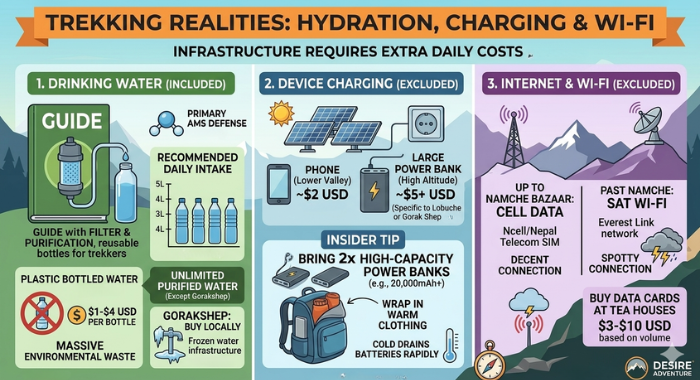
Operating infrastructure above 4,000 meters requires solar energy and satellite networks, which introduces extra daily costs for travelers.
Drinking Water (Included): Staying hydrated is your primary defense against altitude sickness; you should drink 4 to 5 liters of fluid daily. Buying plastic bottled water on the trail is expensive ($1 to $4 USD per bottle) and creates massive environmental waste. We include unlimited purified drinking water for the entire trek (except at Gorakshep, where water must be bought locally due to freezing infrastructure). Our guides use safe filtration or chemical purification systems to refill your reusable bladders or bottles.
Device Charging (Excluded): Lodges charge a fee to plug into their solar grid. Prices range from $2 USD for a phone in the lower valleys to $5+ USD to charge a large power bank in Lobuche or Gorak Shep. Insider Tip: Bring two high-capacity power banks (20,000mAh+) and keep them wrapped in your warm clothing inside your pack; cold temperatures drain lithium batteries rapidly.
Internet & Wi-Fi (Excluded): Cellular data (using a local Ncell or Nepal Telecom SIM card purchased in Kathmandu) works decently up to Namche Bazaar. Past that, you will rely on localized satellite Wi-Fi networks like Everest Link. You can purchase internet data cards directly at the tea houses for roughly $3 to $10 USD depending on the data volume. Be prepared for spotty connections during heavy cloud cover or storms.
High-Altitude Insurance Requirements & Helicopter Protocols
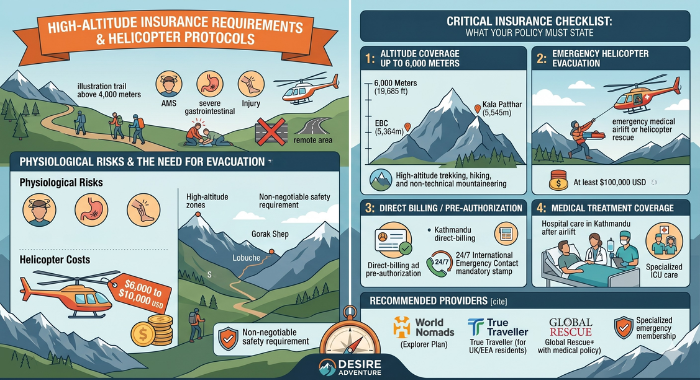
Trekking above 4,000 meters presents undeniable physiological risks. While our team does everything to ensure a safe, gradual ascent, Acute Mountain Sickness (AMS), severe gastrointestinal infections, or sudden physical injuries can happen. In the remote corners of the Khumbu valley, there are no roads; if a medical crisis occurs, a helicopter evacuation is the only viable option.
Because a single rescue flight from high-altitude zones like Lobuche or Gorak Shep can cost anywhere between $6,000 to $10,000 USD, travel insurance is not a box to tick - it is a non-negotiable safety requirement.
Critical Insurance Checklist: What Your Policy Must State
Standard travel insurance policies almost always fail to cover an Everest Base Camp trek. Most basic plans cap their adventure coverage at 3,000 or 4,000 meters. For your expedition with Desire Adventure, you must verify that your insurance provider explicitly includes the following clauses in writing:
Altitude Coverage up to 6,000 Meters: Your policy must explicitly state that it covers "high-altitude trekking," "hiking," or "non-technical mountaineering" up to 6,000 meters (19,685 ft). This safely encompasses Everest Base Camp (5,364m) and the Kala Patthar viewpoint (5,545m).
Emergency Helicopter Evacuation: The policy must specifically mention emergency medical airlift or helicopter rescue. Ensure the financial cap for evacuation is at least $100,000 USD.
Direct Billing / Pre-Authorization: Check if your provider operates on a direct-billing system with operators in Kathmandu or if they utilize a "pay-and-claim" model. Having a 24/7 international emergency contact number is mandatory.
Medical Treatment Coverage: Ensure you have an emergency medical coverage to handle hospital stays, diagnostics, or specialized ICU care once you are airlifted back to Kathmandu.
Recommended Providers: Reliable global insurers that offer appropriate high-altitude tiers for Nepal include World Nomads (Explorer Plan), True Traveller (for UK/EEA residents), and specialized emergency memberships like Global Rescue (paired with a medical policy).
Our Strict Safety & Rescue Protocol: Protecting You from Scams
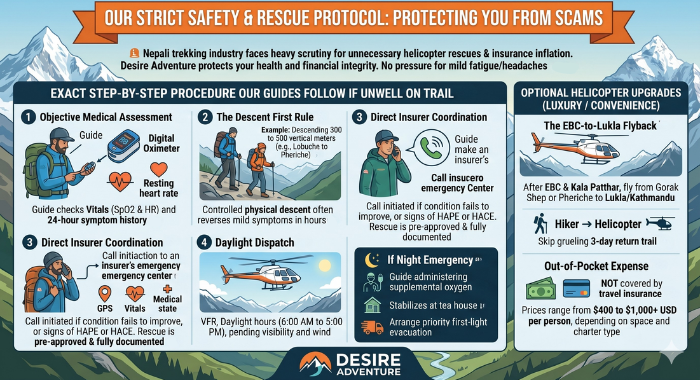
The Nepali trekking industry faces heavy international scrutiny regarding unnecessary helicopter rescues and insurance inflation. At Desire Adventure, we protect both your health and your financial integrity. We never pressure a client into a helicopter seat based on mild fatigue or minor headaches.
Here is the exact step-by-step procedure our guides follow if you feel unwell on the trail:
Objective Medical Assessment: We pause. Your guide will use the digital Pulse Oximeter from our medical kit to check your oxygen saturation and resting heart rate. We cross-reference these numbers with your symptom history over the past 24 hours.
- The Descent First Rule: If you show early signs of mild AMS but are mentally sharp and stable, our first response is always safe, controlled physical descent. Dropping down just 300 to 500 vertical meters (for example, descending from Lobuche to Pheriche) frequently reverses mild symptoms within a matter of hours.
- Direct Insurer Coordination: If your condition fails to improve, or if our guide identifies clear signs of High Altitude Pulmonary Edema (HAPE) or Cerebral Edema (HACE), we initiate an emergency call. We connect you directly with your insurance company’s emergency center to share your exact GPS coordinates, vitals, and medical state. This ensures your rescue is pre-approved and fully documented.
- Daylight Dispatch: Helicopters in the Himalayas fly under Visual Flight Rules (VFR) and operate only during daylight hours (typically 6:00 AM to 5:00 PM), pending clear visibility and stable wind conditions. If an emergency occurs at night, our guide will administer supplemental oxygen, stabilize you at the tea house, and arrange for a priority first-light evacuation.
Optional Helicopter Upgrades (Luxury / Convenience)
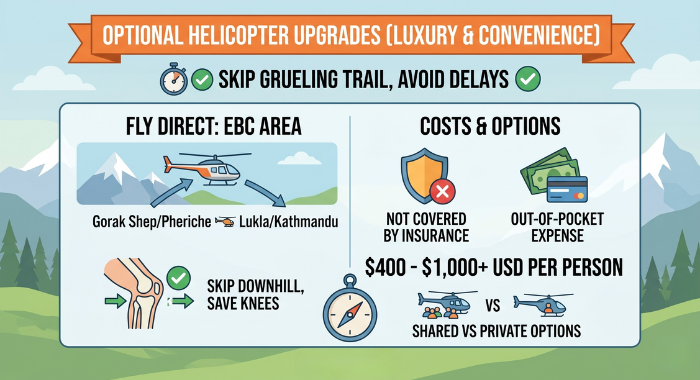
If you wish to skip the grueling 3-day return trek from Base Camp down to Lukla, or if you want an absolute guarantee against peak-season Lukla flight delays, we can coordinate private helicopter charters for you.
The EBC-to-Lukla Flyback: After successfully reaching Base Camp and hiking Kala Patthar, you can fly directly from Gorak Shep or Pheriche back to Lukla or Kathmandu. This saves your knees from days of steep downhill trekking.
Out-of-Pocket Expense: Please note that luxury or convenience flybacks are not covered by travel insurance. If you opt for an optional helicopter return, the cost must be paid entirely out of pocket. Depending on space availability and whether you book a single seat in a shared charter or a private flight, prices typically range from $400 to $1,000+ USD per person.
On the trail
Photo Gallery
Trek Route
Route Map
Elevation Profile
Altitude Chart
Elevation profile across 14 days. Maximum altitude: 5,545m
Common Questions
Frequently Asked
The Everest Base Camp Trek is classified as a challenging high-altitude trek. You do not need technical mountaineering experience, ropes, or ice axes, as it is entirely a walking trail. However, you will hike for 5 to 8 hours daily over steep stone steps, rocky moraine, and exposed terrain.The primary challenge is adapting to the thin air at elevations up to 5,550 meters. We recommend regular cardiovascular training, stair climbing, and strength conditioning for 8 to 12 weeks before arrival.
Tipping is a well-established custom in the Himalayan trekking industry and serves as a direct thank-you for the immense physical labor your crew performs. While tipping is voluntary, we recommend budgeting approximately $150 to $200 USD total per trekker for the staff pool. This money is typically pooled together and distributed to your guide and porters on the final evening of the trek in Lukla.
Even though your core meals, lodging, and purified water are covered in our $1,299 USD package, you will need local currency for personal trail luxuries. We recommend budgeting $20 to $30 USD (approx. 2,500 to 4,000 Nepali Rupees) per day. This covers out-of-pocket expenses such as hot showers (outside of our 5 included nights), device charging fees, Wi-Fi tokens, barista coffees, bakery snacks, and bottled drinks. Cash is mandatory; there are no reliable ATMs past Namche Bazaar.
Weather-related delays are common at Lukla Airport. Our 14-day itinerary includes a built-in safety cushion, but if flights are grounded for consecutive days, we immediately coordinate with airline officials to secure priority seats on the next available flight. If a lengthy delay threatens your international flight home, we can help you charter a shared helicopter rescue. Please note that optional helicopter upgrades for convenience are out-of-pocket expenses and require insurance clearance if claimed for medical reasons.
No, you should never drink untreated tap water or river water in the Himalayas. To prevent waterborne illnesses and eliminate plastic bottle waste, Desire Adventure provides unlimited purified drinking water throughout the trek (except at Gorakshep). Our guides use industry-grade filtration or reliable chemical purification methods to fill your reusable water bladders and Nalgene bottles daily.
Our package price is based on twin-sharing accommodation, which is the standard model in the Khumbu region. In lower hubs like Phakding, Namche, and Lukla, we can arrange single private rooms for an additional single supplement fee, subject to early booking. However, at high-altitude points like Lobuche and Gorak Shep, room numbers are strictly limited by local community committees. During the peak trekking seasons, private rooms are structurally unavailable at those high points, and all trekkers must share twin rooms.
Safety is our absolute priority. Our guides carry a medical kit and a digital Pulse Oximeter to monitor your heart rate and oxygen saturation every evening. If you show symptoms of Acute Mountain Sickness (AMS), our first protocol is immediate, controlled physical descent to a lower altitude. If a trekker develops severe conditions like HAPE or HACE, our Kathmandu office directly coordinates with your insurance provider to dispatch an emergency medical helicopter evacuation to the nearest hospital in Kathmandu.
Yes, we can manage common dietary preferences like vegetarian, vegan, and gluten-free diets. The tea house menus are heavily based on rice, lentils, potatoes, and eggs, making vegetarian and vegan dining straightforward. However, if you are strictly celiac or have severe cross-contamination allergies, options become highly restricted because tea house kitchens are small and prepare wheat products daily. If you have severe dietary restrictions, let our Desire Adventure team know during booking so our guide can personally coordinate with the kitchen staff at each lodge.
You do not need to bring all your travel gear into the mountains. Any clothing, suitcases, or electronics that you need for your broader international trip but don't require on the trail can be safely left at your hotel storage room in Kathmandu. This service is standard and completely free of charge. You will pack only your essential mountain gear into the Desire Adventure duffle bag, which our porters will then manage on the domestic flight and trail.
Most tea houses utilize a mix of European Type C (two round pins) and Indian/Nepali Type D and M (three round pins) electrical outlets. We recommend bringing a universal adapter. Past Namche Bazaar, rooms do not have power outlets; all device charging happens via solar or generator matrices in the communal dining halls for a fee. Because sub-zero temperatures deplete lithium-ion batteries rapidly, always keep your phones, camera batteries, and power banks stored inside your sleeping bag or inner jacket pockets overnight.
The "Khumbu Cough" is a persistent, dry hacking cough caused by breathing high volumes of freezing, dry, and dusty air at altitudes above 3,500 meters. It is not an infection, but rather a physical irritation of the respiratory lining. Our guides prevent this by enforcing a strict hydration rule (4–5 liters of fluids daily) and ensuring every client wears a synthetic buff or neck gaiter over their mouth and nose. This traps your breath's natural moisture, humidifying the air before it reaches your lungs.
This is a common misconception: you cannot see the actual summit of Mount Everest from Everest Base Camp itself. Base Camp sits directly beneath the massive ridges of Nuptse and the West Shoulder, which completely block the main peak from view. You visit Base Camp to stand amidst the active glacier, witness the Khumbu Icefall, and experience the expedition atmosphere. To get the definitive, unobstructed panoramic view of Everest’s summit, we hike to the top of Kala Patthar (5,550m) on Day 10.
There is no official government age limit for the Everest Base Camp trek, but it does require sound physical health. We have successfully guided teenagers and trekkers in their late 60s. The main requirement is a healthy cardiovascular system and joints capable of handling sustained uphill and downhill movement. If you have pre-existing medical conditions-particularly respiratory issues like asthma, or cardiovascular concerns-you must obtain medical clearance from your physician before booking this package with us.
Scheduled Group Trips
Available Departures
Join a scheduled group departure for extra discounts and a shared adventure with fellow trekkers.
| Departure Date | Return Date | Duration | Price | Availability | |
|---|---|---|---|---|---|
| 14 Sep 2026 | — | 14 Days | USD 1299 | 3 spots left | |
| 27 Sep 2026 | — | 14 Days | USD 1280 | Only 8 left | |
| 5 Oct 2026 | — | 14 Days | USD 1280 | Only 7 left | |
| 13 Oct 2026 | — | 14 Days | USD 1280 | 8 spots left | |
| 23 Oct 2026 | — | 14 Days | USD 1280 | Only 12 left | |
| 26 Oct 2026 | — | 14 Days | USD 1280 | Only 7 left | |
| 2 Nov 2026 | — | 14 Days | USD 1280 | 9 spots left | |
| 13 Nov 2026 | — | 14 Days | USD 1299 | Only 3 left |